
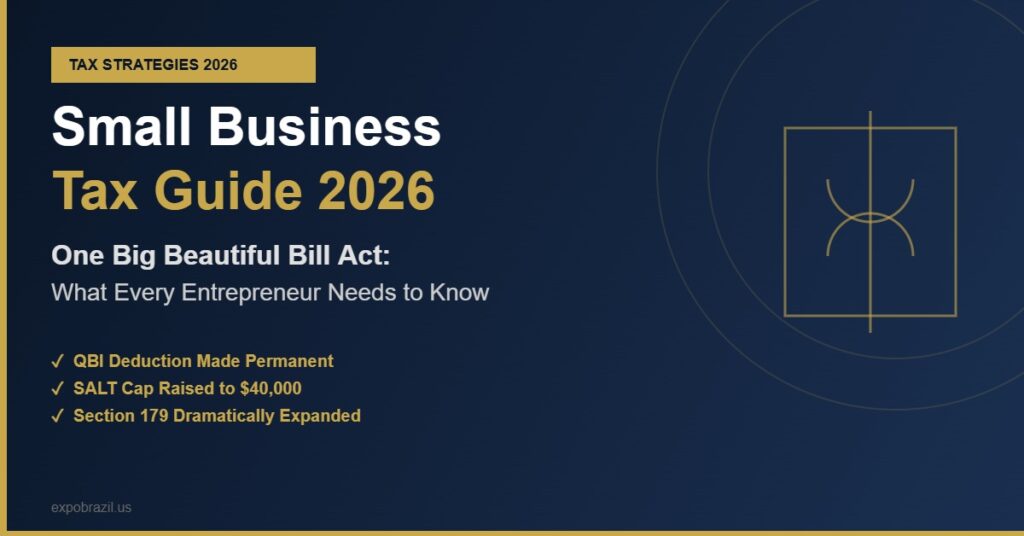
If you own a small business in the United States, 2026 is a year you cannot afford to ignore when it comes to taxes. The One Big Beautiful Bill Act (OBBBA), signed into law on July 4, 2025, introduced some of the most significant tax changes for entrepreneurs and small business owners in nearly a decade. From a permanent Qualified Business Income deduction to a dramatically higher SALT cap and expanded equipment write-offs, the new rules create real opportunities — if you know how to use them.
This guide breaks down the key small business tax strategies for 2026, explains what changed, and shows you how to take action before the end of the tax year.
What Is the One Big Beautiful Bill Act?
The One Big Beautiful Bill Act (OBBBA) is a sweeping tax reform legislation signed by the U.S. government on July 4, 2025. It made several temporary tax provisions permanent, raised key deduction limits, and introduced new benefits specifically designed to help small business owners, self-employed individuals, and pass-through entities such as LLCs, S corporations, and sole proprietorships.
For entrepreneurs — including the growing community of Brazilian business owners operating in the United States — understanding these changes is not optional. It is a competitive advantage.
1. The QBI Deduction Is Now Permanent: What That Means for Your Business
One of the biggest wins for small business owners in the OBBBA is the permanent extension of the Qualified Business Income (QBI) deduction, previously known as the Section 199A deduction.
Before the OBBBA, this deduction was set to expire after the 2025 tax year. Now it is permanent, giving business owners long-term certainty in their tax planning.
How Does the QBI Deduction Work?
The QBI deduction allows eligible business owners to deduct up to 20% of their qualified business income from their federal taxable income. This applies to owners of:
- Sole proprietorships
- Partnerships and multi-member LLCs
- S corporations
- Certain trusts and estates
Under the OBBBA, the income phase-in range was expanded, meaning more business owners qualify for the full deduction. A new minimum deduction of $400 was also introduced for taxpayers with at least $1,000 in qualified business income who actively participate in the business, regardless of income limits.
For a small business generating $150,000 in qualified business income, this deduction alone could reduce your taxable income by $30,000 — a significant saving that directly impacts your bottom line.
2. SALT Deduction Cap Raised to $40,000: A Game-Changer for High-Tax States
The State and Local Tax (SALT) deduction cap was one of the most controversial provisions of the 2017 Tax Cuts and Jobs Act, which limited the deduction to $10,000. The OBBBA has now raised that cap to $40,000 for the 2026 tax year, with a 1% annual increase through 2029.
This is especially important for entrepreneurs who own property, pay significant state income taxes, or operate in states like California, New York, New Jersey, or Illinois — where state and local taxes can be substantial.
For Brazilian entrepreneurs and immigrants living in Florida, where there is no state income tax, the impact of the SALT change is more limited — but it still matters for property taxes and local business taxes.
3. Section 179 Deduction Expanded: Write Off More Equipment in 2026
The Section 179 deduction allows small business owners to immediately deduct the full cost of qualifying equipment and business assets rather than depreciating them over several years. In 2026, the OBBBA significantly expanded this benefit.
Key numbers for 2026:
- Maximum Section 179 deduction: $2,560,000
- Phase-out threshold: $4,090,000 (the deduction begins to reduce dollar-for-dollar above this equipment spending level)
- SUV cap: $32,000 for vehicles placed in service in 2026
Qualifying assets include computers, machinery, office furniture, software, and certain improvements to nonresidential real property. If your business invested in new equipment, vehicles, or technology this year, you may be able to deduct the full cost immediately instead of spreading it over years.
Who Benefits Most from Section 179 in 2026?
Section 179 is particularly powerful for entrepreneurs in industries that depend on physical assets: construction, transportation, food service, retail, beauty services, logistics, and manufacturing. Brazilian business owners expanding operations or investing in new equipment in 2026 should speak with a CPA immediately to maximize this deduction.
4. Retirement Contributions: A Tax Strategy That Builds Wealth and Reduces Taxes
Contributions to retirement accounts remain one of the most powerful and underused tax strategies for small business owners. In 2026, the limits are:
- SEP-IRA: Up to $69,000 (or 25% of net self-employment income)
- Solo 401(k): Up to $69,000 total (employee + employer contributions)
- SIMPLE IRA: Up to $17,000 in employee contributions
- Traditional 401(k): Employee contribution limit of $24,500
Every dollar contributed to a tax-deferred retirement account reduces your taxable income today. A business owner contributing $50,000 to a SEP-IRA could save $15,000 or more in federal taxes, depending on their bracket — while building long-term financial security.
5. Home Office Deduction: Often Missed, Always Valuable
If you run part of your business from home, the home office deduction lets you deduct $5 per square foot of dedicated business space, up to 300 square feet — a maximum deduction of $1,500 using the simplified method.
Alternatively, you can use the regular method, which calculates the actual percentage of your home used for business and applies that to all home expenses (mortgage or rent, utilities, insurance, maintenance). For many entrepreneurs working from home offices in South Florida, this can produce a larger deduction.
The key requirement: the space must be used regularly and exclusively for business.
6. Practical Tax Tips for Small Business Owners in the United States in 2026
Separate Your Business and Personal Finances
One of the most important (and often overlooked) practices is maintaining a completely separate bank account and credit card for your business. This simplifies recordkeeping, protects your personal assets, and ensures you capture every deductible expense.
Track Every Business Expense Year-Round
Tax savings are built throughout the year, not scrambled together in April. Use accounting software like QuickBooks, FreshBooks, or Wave to track and categorize expenses automatically. Common deductible expenses include:
- Business travel, meals (50% deductible), and lodging
- Professional development, courses, and training
- Marketing, advertising, and website costs
- Business insurance premiums
- Professional services (accountant, attorney, consultant fees)
Work with a CPA Who Understands Immigrant Business Owners
For Brazilian entrepreneurs in the United States, working with a bilingual or immigrant-focused CPA is essential. Cross-border tax situations — including income from Brazil, international wire transfers, or foreign bank accounts — carry specific reporting obligations (such as FBAR and FATCA). Getting this wrong can result in costly penalties.
Consider Your Business Structure
The way your business is legally structured affects your taxes significantly. An LLC taxed as an S corporation, for example, can reduce self-employment taxes on a portion of your income. Review your structure with a professional annually, especially as your revenue grows.
How Do These Tax Changes Affect Brazilian Entrepreneurs in the United States?
The Brazilian business community in the United States is growing rapidly. According to the American Immigration Council, immigrant-owned businesses employ approximately 8 million workers in the United States and generate hundreds of billions in economic output annually.
For Brazilian entrepreneurs — many of whom operate small businesses in Florida, Texas, California, and New York — the 2026 tax changes create meaningful opportunities:
- The permanent QBI deduction reduces the tax burden on business profits from LLCs and S corps
- Expanded Section 179 allows immediate write-offs for business equipment and technology investments
- Higher retirement contribution limits help entrepreneurs build wealth while lowering taxable income
- The home office deduction rewards the many immigrant entrepreneurs who run lean, home-based operations
The key is working with the right professionals and staying informed. Events like the Expo Brazil bring together accountants, financial advisors, attorneys, and business owners who can help you navigate these opportunities.
Conclusion: 2026 Is the Year to Get Your Tax Strategy Right
The One Big Beautiful Bill Act has created a more favorable tax environment for small business owners in 2026. The QBI deduction is permanent, the SALT cap is higher, Section 179 is more generous, and retirement contribution limits give entrepreneurs powerful tools to reduce their tax burden legally and strategically.
But tax laws reward those who plan ahead. The best time to implement these strategies is now — not in April 2027. Schedule a meeting with your CPA, review your business structure, and make sure you are capturing every deduction available to you this year.
Expo Brazil is more than an event. It is a business platform created to connect entrepreneurs, brands and opportunities in the United States.
The next edition of Expo Brazil will take place on April 10 and 11, 2027, from 11:00 AM to 5:00 PM, at Osceola Heritage Park, 1901 Chief Osceola Trail, Kissimmee, FL.
Learn more at https://expobrazil.us/ and follow us on Instagram: https://www.instagram.com/expobrazil/
References
- IRS.gov – Small Business Resources
- Paychex – Small Business Tax Planning: 15 Ways to Save in 2026
- Millan CPA – 2026 Business & Pass-Through Tax Rules
- Warren Averett – OBBBA Breakdown: QBI Deduction
- Block Advisors – Section 179 Deduction Guide 2026
- Taxfyle – 2026 Business Tax Planning Guide