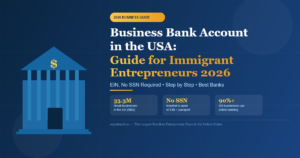

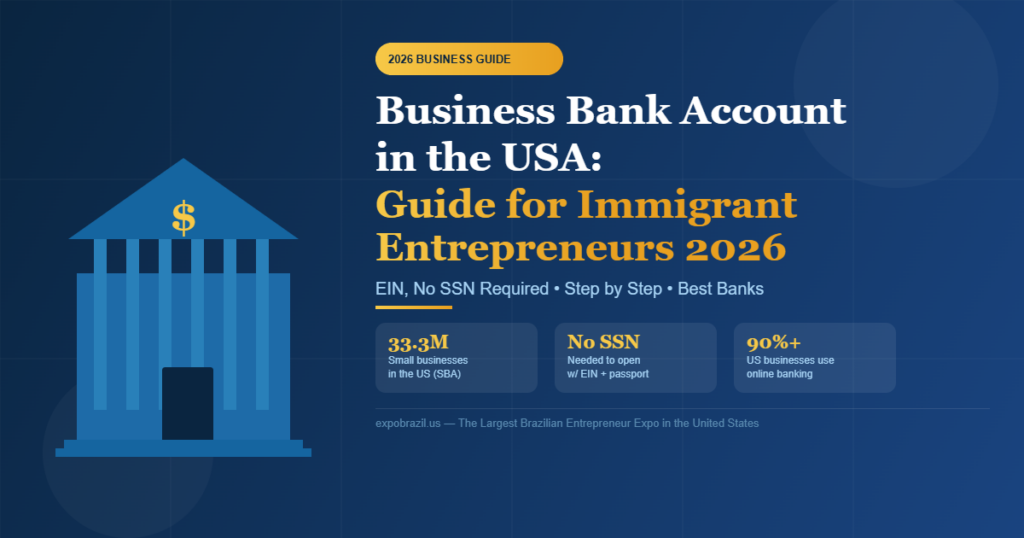
More than 33.3 million small businesses operate in the United States as of 2024 — and a growing share are owned by foreign-born entrepreneurs who must navigate the U.S. banking system without a Social Security Number (SSN), according to the U.S. Small Business Administration. The good news: you do not need an SSN to open a business bank account in the United States. With an Employer Identification Number (EIN), a valid passport, and the right bank, immigrant entrepreneurs can access full business banking services in as little as three to seven business days.
For Brazilian entrepreneurs building businesses in the United States, having a dedicated U.S. business bank account is not optional — it is the financial foundation that separates a legitimate operation from an informal one. Without it, you cannot accept business payments, build business credit, or qualify for business financing. This guide covers everything you need to know to open a U.S. business bank account as an immigrant in 2026.
Why a U.S. Business Bank Account Is Non-Negotiable
More than 90% of U.S. small businesses use online or mobile banking to manage accounts, make payments, and move money, according to banking industry data. A business bank account is not just a place to store money — it is a strategic tool that allows you to:
- Separate personal and business finances (required for LLC liability protection)
- Accept payments from clients and platforms like PayPal, Stripe, and Square
- Build a U.S. business credit history independent of your personal credit
- Qualify for business loans, lines of credit, and SBA financing
- File U.S. business taxes with clean, auditable financial records
- Demonstrate legitimacy to customers, partners, and investors
Operating through a personal account — or worse, through cash — creates serious legal and tax exposure that can jeopardize the very business you are building.
What You Need Before Opening a U.S. Business Bank Account
The requirements vary slightly by bank, but most U.S. financial institutions — including digital-first banks like Mercury and Relay — require the following documents:
1. Employer Identification Number (EIN)
The EIN — also called a Federal Tax Identification Number — is issued by the IRS and is the primary identifier banks use to verify your business. You do not need an SSN to obtain an EIN. Non-resident aliens and foreign nationals can apply by submitting IRS Form SS-4 via mail or fax. Processing time is typically 4 to 7 business days. Importantly, you do not need to be a U.S. citizen, Green Card holder, or even a visa holder to obtain an EIN or open an LLC in the United States.
2. Business Formation Documents
You will need proof that your business is legally registered in the United States. This typically means your Articles of Organization (for an LLC) or Articles of Incorporation (for a Corporation), along with your Certificate of Formation or Operating Agreement. If you formed your LLC in Florida, for example, your registration documents come from the Florida Division of Corporations (Sunbiz.org).
3. Government-Issued Photo ID
Most banks require one or two forms of government-issued ID. For foreign nationals, a valid international passport with at least 6 months before expiration is the primary accepted document. Some banks also accept a foreign driver’s license as a secondary form of ID. You do not need a U.S. driver’s license or state ID.
4. U.S. Business Address
Banks require a legitimate U.S. street address for your business — not a basic P.O. Box. In 2026, most banks run internal security scans on addresses. Acceptable options include a registered agent address, a virtual mailbox service with a real suite number (such as Earth Class Mail or Anytime Mailbox), or a physical office lease. A unique suite number associated with a recognized business address provider is generally sufficient.
5. Beneficial Ownership Information
Under the U.S. Bank Secrecy Act and FinCEN’s beneficial ownership rules, banks must collect ownership information for any individual owning 25% or more of the business. You will need to provide your name, date of birth, address, and a copy of your passport for each beneficial owner.
Frequently Asked: Do I Need a Social Security Number to Open a Business Bank Account in the United States?
No. You do not need a Social Security Number (SSN) to open a U.S. business bank account. Banks primarily require an Employer Identification Number (EIN), which any foreign national can obtain from the IRS by filing Form SS-4 — regardless of immigration status. Many fintech banks such as Mercury, Relay, and Lili specifically accommodate foreign-owned U.S. LLCs without requiring an SSN or even a U.S. visa.
Step-by-Step: How to Open a U.S. Business Bank Account as an Immigrant
Follow these steps in order to set up your U.S. business banking correctly in 2026:
- Register your U.S. LLC or Corporation. Choose your state (Florida, Delaware, Wyoming, and Texas are popular for Brazilian entrepreneurs). Filing fees range from $35 (Wyoming) to $125 (Florida) as of 2026.
- Get your Registered Agent. Most states require a registered agent with a physical address in the state. Services typically cost $50–$150/year.
- Apply for your EIN. Submit IRS Form SS-4 by fax or mail. International fax: +1-859-669-5760. No SSN required. Allow 4–7 business days.
- Secure a U.S. business address. Use a virtual mailbox with a unique suite number. Verify that the address passes bank security scans before applying.
- Choose your bank and apply online. Digital-first banks (Mercury, Relay) accept online applications from founders living abroad. Traditional banks require an in-person visit at a U.S. branch.
- Submit your documents. EIN letter, business formation documents, passport, and business address documentation.
- Receive approval and fund your account. Approval typically takes 3–7 business days. Many banks require an initial deposit of $0–$100 to activate the account.
Best Banks for Immigrant Entrepreneurs in the USA in 2026
Not all banks are equally friendly to foreign-owned businesses. Here is a comparison of the top options for immigrant entrepreneurs in 2026:
Mercury — Best for Digital-First Entrepreneurs
Mercury is the top choice for foreign-owned LLCs and startups. It offers free business checking and savings accounts with no monthly fees, accepts founders living abroad, and does not require an in-person visit or an SSN. The application is 100% online. Mercury Treasury earns up to 3.65% APY (as of early 2026) on balances above $250,000, and accounts are typically approved within 3 to 5 business days. Note: Mercury does not support cash deposits.
Relay — Best for Multi-Account Financial Organization
Relay allows businesses to open up to 20 separate checking accounts and 2 savings accounts under one login — each with its own debit card. This makes it ideal for entrepreneurs using the Profit First budgeting method (separating operating expenses, taxes, owner’s draw, and payroll). Relay pays 0.91%–2.68% APY on savings balances, charges no monthly fees, and accepts applications from foreign-owned U.S. LLCs.
Bluevine — Best for Interest on Balances
Bluevine Business Checking pays up to 2.0% APY on balances up to $250,000 — one of the highest rates among fee-free business accounts. It also integrates directly with QuickBooks, making it attractive for entrepreneurs who want automated bookkeeping. No monthly fees, no minimum balance requirements.
Chase Business Complete Banking — Best for In-Person Banking
Chase has over 4,700 branches and 15,000 ATMs nationwide — making it the best option for businesses that deal in cash or need in-person banking services. The Business Complete Banking account costs $15/month, but the fee is waived with a minimum daily balance of $2,000. Chase is the best choice for immigrant entrepreneurs who already have a U.S. presence and prefer traditional banking relationships, including access to Chase lending products.
Bank of America — Best ITIN-Friendly Traditional Bank
Bank of America is widely recognized for accepting ITINs (Individual Taxpayer Identification Numbers) for checking accounts and credit cards. If you have an ITIN instead of an SSN, Bank of America and many local credit unions are among the most accessible traditional banking options. An ITIN is not required to open a business account, but having one in addition to your EIN can improve your options at traditional banks.
Online-First Banks vs. Traditional Banks: Which Is Right for You?
The decision between a digital-first bank and a traditional institution depends on your business model and your presence in the U.S.:
- Choose online-first (Mercury, Relay, Bluevine) if you operate remotely, do not deal in cash, want no monthly fees, and prefer a fast, fully digital application process.
- Choose a traditional bank (Chase, Bank of America) if your business handles cash, you need in-person service, or you want to build a direct relationship for future lending — such as a business line of credit or SBA loan.
Community banks with assets under $250 million allocate 12.6% of their total assets to small business loans — more than three times the rate of large banks (3.6%), according to FDIC data. If long-term credit access is a priority, establishing a relationship with a community bank early can pay dividends.
Common Mistakes Immigrant Entrepreneurs Make When Opening a U.S. Business Bank Account
- Using a P.O. Box as the business address. Basic P.O. Boxes are rejected by most banks’ security systems. Use a virtual mailbox with a real suite number instead.
- Applying without an EIN. Many entrepreneurs try to apply with only their passport and ITIN. Most banks require the EIN specifically — not the ITIN — because the EIN is issued to the business, not the individual.
- Mixing personal and business finances before opening the account. Once your LLC is formed, all business income and expenses must flow through the business account to maintain your liability shield.
- Choosing a bank based only on fees. Fee structure matters, but so do integration with accounting software, customer support quality, access to credit, and compatibility with payment processors.
- Ignoring the 2026 beneficial ownership reporting requirements. Under the Corporate Transparency Act, most U.S. LLCs must report beneficial ownership information to FinCEN. Non-compliance can affect your ability to maintain banking relationships.
Expo Brazil: Where Immigrant Entrepreneurs Connect and Grow
The Expo Brazil, the largest Brazilian entrepreneur expo in the United States, takes place on April 10–11, 2027, at Osceola Heritage Park in Kissimmee, FL. The 2026 edition featured more than 140 exhibitors, over 4,000 visitors, and a social media reach exceeding 500,000 people — making it the premier event for Brazilian entrepreneurs doing business in the U.S.
Frequently Asked Questions: Business Bank Account for Immigrant Entrepreneurs in the USA
Can I open a US business bank account without visiting the United States?
Yes. Digital-first banks like Mercury and Relay allow founders living abroad to open a U.S. business bank account entirely online. You need a U.S.-registered LLC, an EIN (obtainable by fax from outside the U.S.), a valid international passport, and a U.S. business address. No in-person visit is required.
Do I need an ITIN to open a US business bank account as an immigrant?
No. An ITIN is not required to open a U.S. business bank account. The key requirement is an EIN, which is issued to the business and can be obtained regardless of immigration status or SSN. Fintech banks like Mercury and Relay do not require an ITIN.
How long does it take to open a US business bank account as a foreigner?
Once you have your EIN and business documents, digital-first banks typically approve accounts within 3 to 7 business days. Obtaining the EIN from the IRS takes 4 to 7 business days by fax for non-U.S. applicants.
What is the best bank for Brazilian entrepreneurs in the United States in 2026?
Mercury is widely considered the best bank for foreign-owned U.S. LLCs in 2026 — free checking, online applications from abroad, no SSN required, same-day ACH. Relay is the top alternative for multi-account budgeting. For cash-intensive businesses or future lending needs, Chase or a local community bank may be more appropriate.
Conclusion: Your U.S. Business Bank Account Is the Foundation of Everything Else
Opening a U.S. business bank account as an immigrant entrepreneur is more straightforward than most people expect. You do not need a Social Security Number, a U.S. visa, or even to be physically present in the United States. What you need is an EIN, a properly registered U.S. LLC, a valid passport, and a reliable business address. With those in place, digital-first banks like Mercury or Relay can have you fully banked in less than a week.
For Brazilian entrepreneurs building businesses in the United States, establishing a solid banking foundation is step one of a long-term strategy — one that leads to business credit, financing, scaling, and ultimately to the kind of business success that events like the Expo Brazil celebrate every year.
Expo Brazil is more than an event. It is a business platform created to connect entrepreneurs, brands and opportunities in the United States.
The next edition of Expo Brazil will take place on April 10 and 11, 2027, from 11:00 AM to 5:00 PM, at Osceola Heritage Park, 1901 Chief Osceola Trail, Kissimmee, FL.
Learn more at https://expobrazil.us/ and follow us on Instagram: https://www.instagram.com/expobrazil/
References
- U.S. Small Business Administration – Small Business Profile 2024: sba.gov
- FDIC – Small Business Lending Survey 2024: fdic.gov
- IRS – Apply for an Employer Identification Number (EIN): irs.gov
- Mercury Bank – Business Banking for Startups and Foreign-Owned LLCs: mercury.com
- Relay Financial – Best Online Business Bank Accounts 2026: relayfi.com
- Lili – Top U.S. Business Bank Accounts for Non-Residents in 2026: lili.co
- Manay CPA – U.S. Banking Guide for Foreign Entrepreneurs 2026: manaycpa.com
- FinCEN – Beneficial Ownership Information Reporting: fincen.gov
Disclaimer
The information published in this article is based on publicly available data from reliable sources, official publications, and research available at the time of writing. Business statistics, market data, regulatory requirements, tax rules, and all other details referenced in this article are subject to change without prior notice.
Expo Brazil makes no representations or warranties — express or implied — regarding the accuracy, completeness, or timeliness of any information contained herein. This article is intended for general informational purposes only and does not constitute legal, financial, tax, or business advice. Readers are strongly encouraged to verify all information directly through official government agencies, licensed professionals, and authoritative sources before making any business, financial, or investment decisions.
Last updated: May 30, 2026 · Expo Brazil Editorial Team · Contact Us