
Small businesses in the United States faced an average of $36,000 in out-of-pocket losses per lawsuit in 2024, according to data from the U.S. Small Business Administration — and 43% of small business owners reported being sued at least once in their lifetime, according to the U.S. Chamber Institute for Legal Reform. With over 33.3 million small businesses operating across the country in 2026, having the right business insurance is no longer optional: it is one of the most critical financial decisions an entrepreneur can make.
For Brazilian entrepreneurs building businesses in the United States, understanding the American insurance system is especially important. The rules differ significantly from Brazil, and gaps in coverage can expose owners to lawsuits, property loss, employee claims, and even business closure. This guide covers everything you need to know to choose the right coverage in 2026.
Why Business Insurance Is Non-Negotiable in the USA
The United States is one of the most litigious countries in the world. A single customer slip-and-fall at your store, a data breach affecting client records, or a fire destroying your inventory can trigger costs far beyond what most small business owners can absorb. Business insurance creates a financial buffer between your company and events you cannot control.
Beyond financial protection, many clients, landlords, and government contracts require proof of insurance before you can do business with them. General liability coverage is frequently a mandatory requirement in commercial lease agreements across major U.S. cities.
What Business Insurance Is Required by Federal Law in the USA?
The federal government mandates three types of insurance for every business that has employees in the United States:
- Workers’ Compensation: Covers medical expenses and lost wages for employees injured on the job. Required in nearly every U.S. state once you have at least one employee.
- Unemployment Insurance: Funded through state and federal payroll taxes, providing temporary income to employees who lose their jobs involuntarily.
- Disability Insurance: Required in California, Hawaii, New Jersey, New York, Rhode Island, and Puerto Rico. Provides partial wage replacement for employees unable to work due to a non-work-related illness or injury.
Individual states may require additional coverage — for example, Florida requires workers’ compensation for construction businesses with one or more employees, while other industries in Florida require it at four or more employees. Always verify your state’s specific requirements through your state’s Division of Workers’ Compensation.
The 6 Essential Types of Business Insurance for Small Businesses in 2026
1. General Liability Insurance
General liability insurance is the most fundamental coverage for any small business. It protects against third-party claims for bodily injury, property damage, and advertising injury (such as libel or slander). If a customer is injured in your store, if you accidentally damage a client’s property, or if a competitor sues you over an advertisement, general liability steps in to cover legal fees and settlements.
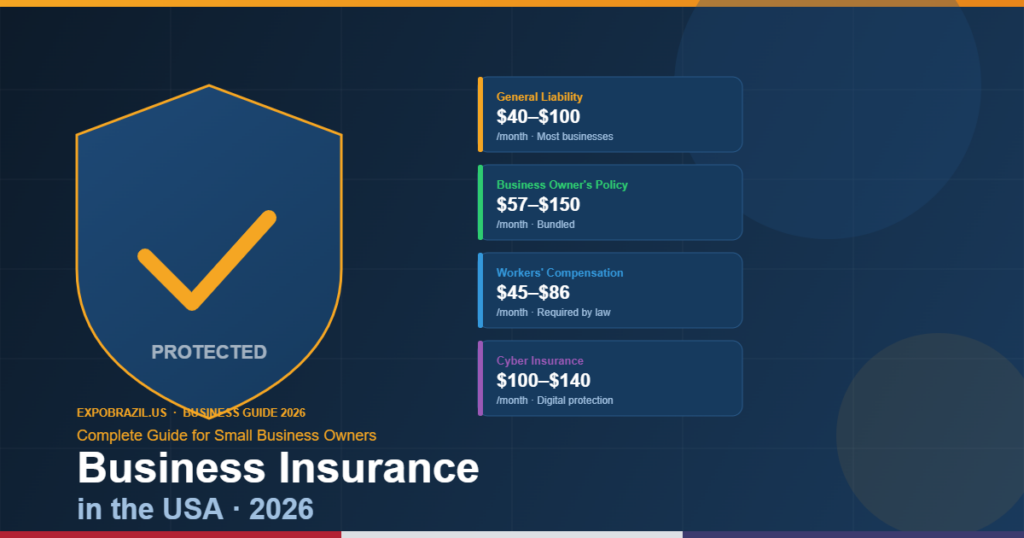
2026 cost: $40 to $100 per month for most small businesses, or $500 to $1,200 per year, according to Insureon and MoneyGeek.
2. Professional Liability Insurance (Errors & Omissions)
Essential for service-based businesses — consultants, accountants, designers, marketing agencies, lawyers, and any company that charges for advice or professional services. Professional liability insurance, also known as Errors & Omissions (E&O), protects against claims that your service caused financial harm to a client, even if no error was actually made.
2026 cost: $50 to $150 per month depending on industry risk and business revenue.
3. Commercial Property Insurance
This policy covers physical assets — your building, equipment, inventory, and furniture — against fire, theft, vandalism, and certain natural disasters. It is critical for businesses with significant physical infrastructure, including retail stores, restaurants, warehouses, and service centers.
2026 cost: Varies widely based on location, building value, and industry. Average annual premium for small businesses is approximately $750 to $1,500.
4. Business Owner’s Policy (BOP)
A Business Owner’s Policy bundles general liability, commercial property insurance, and business interruption coverage into a single package at a lower combined cost than buying each policy separately. BOP is designed specifically for small and mid-sized businesses and is the most cost-efficient starting point for most entrepreneurs.
2026 cost: $57 to $150 per month, or approximately $684 per year on average — saving 20–30% compared to buying individual policies, according to MoneyGeek.
5. Workers’ Compensation Insurance
Beyond the federal mandate, workers’ compensation is a practical safeguard for any business with employees. It covers medical treatment, rehabilitation, and lost wages for employees injured or made ill by their work — and protects the employer from being sued directly by injured workers in most states.
2026 cost: $45 to $86 per month on average, or approximately $540 to $1,032 per year, according to The Hartford and Next Insurance. Cost varies significantly by industry risk level — construction businesses pay more than office-based businesses.
6. Cyber Liability Insurance
Cyber insurance has become a standard line item for small businesses in 2026. If your business accepts credit cards, stores customer data, or uses cloud-based software — and nearly every business does — a data breach or ransomware attack could result in regulatory fines, legal claims, and notification costs that exceed your annual revenue. The average cost of a data breach for a small business in the U.S. reached $4.88 million in 2024, according to IBM’s Cost of a Data Breach Report.
2026 cost: $100 to $140 per month for most small businesses, according to Homebase Insurance Cost Guide.
2026 Business Insurance Cost Summary
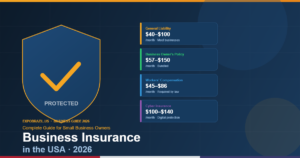
| Insurance Type | Monthly Cost | Annual Cost | Who Needs It |
|---|---|---|---|
| General Liability | $40–$100 | $500–$1,200 | All businesses |
| BOP (bundled) | $57–$150 | $684–$1,800 | Most small businesses |
| Workers’ Compensation | $45–$86 | $540–$1,032 | Businesses with employees |
| Professional Liability (E&O) | $50–$150 | $600–$1,800 | Service-based businesses |
| Cyber Insurance | $100–$140 | $1,200–$1,680 | Businesses handling digital data |
| Commercial Auto | $200–$245 | $2,400–$2,940 | Businesses using vehicles |
A sole proprietor with one location and no employees typically budgets $100 to $200 per month for a basic general liability or BOP package. When you hire your first employee, expect total insurance costs to increase by approximately $2,500 per year — adding workers’ compensation and expanding liability coverage, according to Homebase Insurance Cost Guide 2026.
Frequently Asked: What Business Insurance Is Required by Law in the USA?
Federal law requires every business with employees in the United States to carry workers’ compensation insurance, unemployment insurance, and disability insurance (in six states and Puerto Rico). States may mandate additional coverage depending on industry and employee count. While general liability insurance is not federally required for most businesses, it is routinely required by commercial landlords, clients, and government contract agencies as a condition of doing business.
4 Steps to Buy the Right Business Insurance in the USA
The U.S. Small Business Administration recommends this four-step process:
- Assess your risks. Identify the specific threats to your business — customer injuries, property damage, professional errors, cyber attacks, or employee injuries. Your industry and location will shape your risk profile significantly.
- Find a licensed commercial insurance agent. Agents specialized in commercial insurance can compare policies across multiple carriers and help you find coverage that matches your risk level and budget. Verify their license through your state’s Department of Insurance.
- Shop around and compare. Get quotes from at least three different providers. Prices for the same coverage can vary by 30–50% between insurers. Insureon, Next Insurance, Hiscox, and The Hartford are commonly used platforms for small business quotes.
- Re-assess every year. As your business grows — new equipment, additional employees, new locations — your coverage needs change. Review your policies annually and update them before your renewal date.
What Immigrant Entrepreneurs Need to Know About Business Insurance in the USA
Immigrant entrepreneurs building businesses in the United States face the same insurance requirements as U.S.-born business owners. Immigration status does not exempt a business from workers’ compensation mandates, liability claims, or data protection obligations.
Some key points specific to immigrant-owned businesses:
- Insurance is separate from banking and financing. Even with recent SBA lending restrictions affecting non-citizens, all businesses — regardless of owner immigration status — can purchase business insurance through private carriers. No citizenship or residency requirement applies to obtaining commercial insurance.
- Contract requirements are common. Many U.S. clients, particularly corporations and government agencies, require vendors to show a Certificate of Insurance (COI) before signing service contracts. Having coverage in place accelerates business development.
- Language and cultural navigation. Look for brokers who work with immigrant business communities. Several national brokers now offer multilingual support and specialize in serving Latino and Brazilian entrepreneurs.
FAQ: Business Insurance for Small Businesses in the USA in 2026
Conclusion: Protect Your Business Before You Need To
Business insurance in the USA in 2026 is not a luxury — it is the foundation of responsible entrepreneurship. From general liability to cyber coverage, the right policies protect your company, your employees, and your personal assets from risks that no business owner can fully predict or prevent.
The good news: for most small businesses, comprehensive coverage starts at under $200 per month. The cost of not having insurance — a single lawsuit, a fire, or a data breach — can easily reach tens of thousands of dollars or more. The math is clear.
For Brazilian entrepreneurs operating in the United States, building a solid insurance foundation is one of the most important steps you can take before scaling your business. The Expo Brazil, the largest Brazilian entrepreneur expo in the United States, takes place on April 10–11, 2027, at Osceola Heritage Park in Kissimmee, FL — bringing together experts, networks, and opportunities to help you grow your business the right way.
About Expo Brazil
Expo Brazil is more than an event. It is a business platform created to connect entrepreneurs, brands and opportunities in the United States.
The next edition of Expo Brazil will take place on April 10 and 11, 2027, from 11:00 AM to 5:00 PM, at Osceola Heritage Park, 1901 Chief Osceola Trail, Kissimmee, FL.
Learn more at https://expobrazil.us/ and follow us on Instagram: https://www.instagram.com/expobrazil/
References
- U.S. Small Business Administration — Get Business Insurance
- Homebase — Small Business Insurance Cost Guide 2026
- MoneyGeek — Average Small Business Insurance Cost (2026)
- The Hartford — Workers’ Compensation Cost Data 2026
- IBM — Cost of a Data Breach Report 2024
- Insureon — Small Business Insurance Cost
- U.S. Chamber Institute for Legal Reform — Lawsuit Statistics
- SBA Office of Advocacy — Small Business Profile 2024
Disclaimer
The information published in this article is based on publicly available data from reliable sources, official publications, and research available at the time of writing. Business statistics, market data, regulatory requirements, tax rules, and all other details referenced in this article are subject to change without prior notice.
Expo Brazil makes no representations or warranties — express or implied — regarding the accuracy, completeness, or timeliness of any information contained herein. This article is intended for general informational purposes only and does not constitute legal, financial, tax, or business advice. Readers are strongly encouraged to verify all information directly through official government agencies, licensed professionals, and authoritative sources before making any business, financial, or investment decisions.
Last updated: May 31, 2026 · Expo Brazil Editorial Team · Contact Us