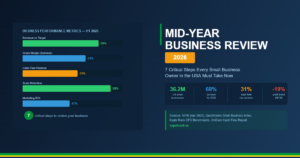

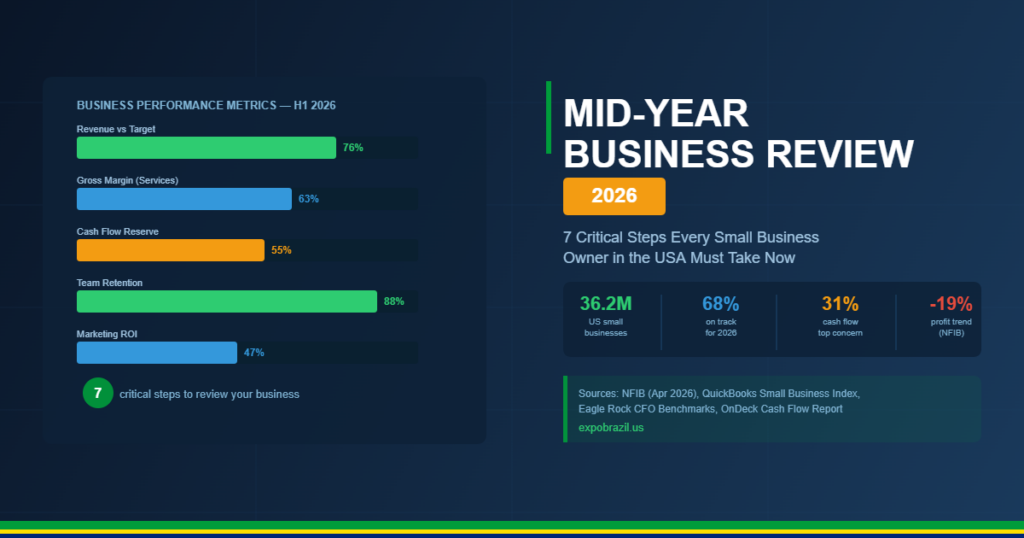
With 36.2 million small businesses operating in the United States in 2026 — accounting for 43.5% of the nation’s GDP and employing 46.5% of the private-sector workforce, according to the U.S. Small Business Administration — only 68% are currently on track to meet their annual projections, per the QuickBooks Small Business Index Annual Report. June marks the exact midpoint of the year: a critical window for every entrepreneur to stop, examine the numbers, and make decisive adjustments before Q3 spending locks in your trajectory.
The NFIB Small Business Optimism Index stood at 95.9 in April 2026 — below its 52-year historical average of 98.0 for the second consecutive month — with cash flow pressures emerging as the top concern for 31% of business owners, surpassing inflation (29%) for the first time ever. If you have not yet conducted a formal mid-year review, this guide gives you 7 concrete, data-backed steps to assess your performance and reset your strategy for a stronger second half of 2026.
Why a Mid-Year Business Review Is Non-Negotiable in 2026
Business conditions in 2026 are shifting faster than ever. Rising tariffs, persistent inflation, a 60% increase in customer acquisition costs over the past five years, and a tightening labor market — where 18% of small business owners now name labor quality as their single most important challenge (NFIB, April 2026) — make it impossible to run a business on autopilot. A structured mid-year review separates what is working from what is not, allows you to reallocate resources accordingly, and ensures you enter the second half of the year with a clear, data-backed plan.
According to analysis from the KPI Institute, companies that conduct formal mid-year reviews extend their operational runway by 20–30% on average compared to those that wait for a year-end assessment. In 2026, with 93% of small business owners expecting growth but only 32% expecting significant growth (a survey all-time high per QuickBooks), the gap between ambition and execution is exactly where mid-year reviews make the difference.
Frequently Asked: What Should a Small Business Review at Mid-Year?
A mid-year business review should cover seven core areas: revenue versus projections, gross profit margin, cash flow position, customer acquisition cost and lifetime value ratio, team performance and retention, marketing ROI by channel, and operational costs. Each metric should be compared against your January goals and against published industry benchmarks for your sector. Any metric that deviates by more than 15% from plan requires immediate strategic attention before Q3 begins.
Step 1 — Review Revenue vs. Projections
Start by comparing your actual revenue for January through May 2026 against your annual plan. If you are on schedule, you should have collected approximately 41.7% of your annual revenue target (five months out of twelve). If your actual revenue falls short by more than 5 percentage points, calculate the gap in dollar terms and determine whether it is a pricing problem, a volume problem, or a market problem — each requires a different strategic response.
How to Calculate Your Revenue Gap
Formula: Revenue Gap = (Annual Target × 41.7%) − Actual Revenue (Jan–May). If positive, you are behind. If negative, you are ahead. Example: if your annual target is $500,000 and you collected $190,000 through May, your gap is $18,500 — roughly one additional client per month needed in H2. According to the QuickBooks Small Business Index Annual Report 2026, 32% of US small business owners expect significant growth this year — but only if they identify and close revenue gaps before Q3.
Step 2 — Analyze Your Gross Profit Margin
Gross profit margin is one of the most reliable indicators of business health. Industry benchmarks for 2026, compiled by Eagle Rock CFO from SEC filings and NYU Stern data (updated through Q1 2026): retail 25–50%, service businesses 50–70%, manufacturing 30–45%, restaurants 60–70%, software/SaaS 70–85%. If your margin falls significantly below your industry benchmark, you have either a pricing problem or a cost-of-goods problem — both correctable in H2 with deliberate action.
Industry Gross Margin Benchmarks for 2026
| Industry | Target Gross Margin (2026) |
|---|---|
| Retail | 25–50% |
| Services | 50–70% |
| Manufacturing | 30–45% |
| Restaurants | 60–70% |
| Software / SaaS | 70–85% |
| E-Commerce | 30–50% |
Step 3 — Assess Your Cash Flow Position and Working Capital
Cash flow pressure is the number one operational concern for US small business owners in 2026, cited by 31% of owners — surpassing inflation (29%) for the first time, per OnDeck’s Small Business Cash Flow Trend Report. A healthy mid-year cash flow review answers three questions: (1) Do you have at least 60–90 days of operating expenses in liquid reserves? (2) Are accounts receivable under 45 days outstanding? (3) Are there large Q3 or Q4 expenses that require financing action now?
Critically: the net percent of small business owners with a positive profit trend stands at a net negative 19% in 2026, per the NFIB — more owners report declining profits than improving ones. Cash flow review is not optional. It is the single most critical safeguard for surviving the second half of the year.
Step 4 — Evaluate Customer Acquisition Cost and Lifetime Value Ratio
Customer acquisition cost (CAC) has risen 60% over the past five years across all US industries. The current average blended CAC is approximately $300 (Optifai Sales Ops Benchmark, Q1–Q3 2025, N=939 companies), with referral channels averaging $150 and outbound reaching up to $1,980. The gold standard LTV-to-CAC ratio is 3:1 at minimum — for every $1 acquiring a customer, that customer should generate at least $3 in lifetime value. Below 2:1 signals an immediate problem. Above 5:1 often means underinvestment in acquisition.
At mid-year, calculate this ratio per channel, not just as a blended average. A 4:1 overall can mask 1:1 on paid ads and 7:1 on referrals — directing you to cut one and double down on the other.
Step 5 — Review Team Performance and Retention Risk
Labor quality is the single most important business problem for 18% of US small business owners as of April 2026 (NFIB). A mid-year team review should cover: performance against January goals, employee satisfaction (even an informal one-on-one), and retention risks before they become departures. Replacing an employee costs 50–200% of their annual salary — identifying at-risk talent mid-year costs a fraction of that.
In 2026, 58% of US small businesses are hiring or trying to hire (NFIB). If your review reveals a talent gap, starting now gives you Q3 to recruit and onboard before Q4’s demand spike. Starting in Q4 is consistently too late.
Step 6 — Audit Marketing ROI by Channel
84% of US small to midsize businesses use Facebook as their primary marketing platform in 2026, but usage alone does not determine ROI. Your mid-year marketing audit should calculate cost per lead, cost per conversion, and H1 revenue attributed to each channel. Any channel not generating positive ROI after six months deserves a strategy overhaul or budget reallocation — not another six months of hope.
In 2026, 46% of US small businesses use AI tools in some capacity (QuickBooks Entrepreneurship Trends Report), applied to content creation, email automation, and ad optimization. If your team is not yet using AI to reduce per-lead costs, H2 2026 is the time to pilot. Even a 15% CAC reduction meaningfully improves your LTV-to-CAC ratio without generating a single new sale.
Step 7 — Cut or Restructure Underperforming Operational Costs
With the NFIB profitability trend at net negative 19%, operational cost review is essential — not optional. Audit every recurring expense: software subscriptions, vendor contracts, office leases, service retainers. Ask three questions for each: Is it generating measurable value? Can it be renegotiated? Can it be replaced by a more efficient solution, including AI automation? Businesses that complete a cost audit in Q2 consistently report better net margin in Q4, redirecting savings into growth rather than carrying dead weight through the holiday season.
Frequently Asked: How Do I Know If My Small Business Is Performing Well in 2026?
Your small business is performing well in 2026 if: (1) revenue is ≥41.7% of annual target through May, (2) gross profit margin matches your industry benchmark (25–70% depending on sector), (3) you hold 60+ days of operating expenses in liquid reserves, and (4) your LTV-to-CAC ratio is above 3:1. According to the QuickBooks Small Business Index Annual Report 2026, 68% of US small businesses were on track to meet or exceed 2026 projections as of Q1. If you are not in that group, a structured mid-year review is your most important tool.
How This Applies to Brazilian Entrepreneurs in the United States
For Brazilian-owned businesses in the United States, the mid-year review adds complexity: foreign exchange fluctuations between the real and the dollar, cross-border tax obligations, and the need to demonstrate business health for visa renewals. Brazilian entrepreneurs are among the fastest-growing segments of immigrant business owners in the US — those who review their numbers rigorously at mid-year are better positioned to scale, attract US financing, and present compelling cases to lenders and immigration authorities.
The Expo Brazil, the largest Brazilian entrepreneur expo in the United States, takes place on April 10–11, 2027, at Osceola Heritage Park in Kissimmee, FL — and many exhibiting business owners cite mid-year performance reviews as a key pillar of their US growth strategy.
Frequently Asked Questions About Mid-Year Business Review
Conclusion
A mid-year business review is not a bureaucratic exercise — it is the most practical tool available to an entrepreneur who wants to finish 2026 stronger than they started it. With 36.2 million small businesses competing for market share, customers, and talent in the United States, the businesses that win look at their data honestly, make hard decisions early, and execute with precision in the second half. June is not too early. June is exactly the right time.
If your review reveals gaps in revenue, margin, cash flow, or team performance, you still have six months to close them. The businesses that skip the mid-year review discover these gaps in December — when it is too late to do anything but survive.
Expo Brazil 2027
Expo Brazil is more than an event. It is a business platform created to connect entrepreneurs, brands and opportunities in the United States.
The next edition of Expo Brazil will take place on April 10 and 11, 2027, from 11:00 AM to 5:00 PM, at Osceola Heritage Park, 1901 Chief Osceola Trail, Kissimmee, FL.
Learn more at https://expobrazil.us/ and follow us on Instagram: https://www.instagram.com/expobrazil/
References
- U.S. Small Business Administration. Small Business Facts. sba.gov
- NFIB. Small Business Optimism Index, April 2026. nfib.com
- QuickBooks. Small Business Index Annual Report 2026. quickbooks.intuit.com
- QuickBooks. Entrepreneurship Trends 2026. quickbooks.intuit.com
- Eagle Rock CFO. Gross Margin Benchmarks by Industry 2026. eaglerockcfo.com
- OnDeck. Small Business Cash Flow Trend Report. ondeck.com
- Genesys Growth. Customer Acquisition Cost Benchmarks 2026. genesysgrowth.com
- KPI Institute. Mid-Year Performance Review Resources 2026. kpiinstitute.org
- SellersCommerce. United States Small Business Statistics 2026. sellerscommerce.com
Disclaimer
The information published in this article is based on publicly available data from reliable sources, official publications, and research available at the time of writing. Business statistics, market data, regulatory requirements, and all other details are subject to change without prior notice.
Expo Brazil makes no representations or warranties — express or implied — regarding the accuracy, completeness, or timeliness of any information contained herein. This article is for general informational purposes only and does not constitute legal, financial, tax, or business advice. Readers are strongly encouraged to verify all information directly through official government agencies, licensed professionals, and authoritative sources before making any business, financial, or investment decisions.
Last updated: June 2, 2026 · Expo Brazil Editorial Team · Contact Us