
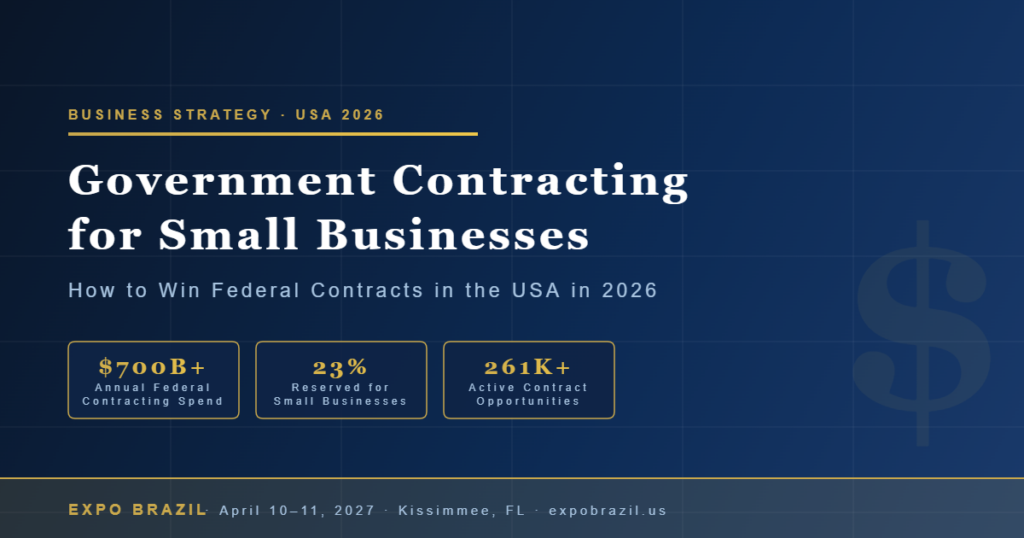
The U.S. federal government awarded $178.6 billion in contracts to small businesses in fiscal year 2023 — representing 28.4% of all eligible federal contracting dollars, according to the U.S. Small Business Administration. In total, the federal government procures over $700 billion worth of goods and services every year, making it the single largest purchaser in the world. By law, at least 23% of those dollars must go to small businesses.
Yet most small business owners — including thousands of Brazilian entrepreneurs operating in the United States — have never seriously explored this market. Government contracting remains one of the most underutilized growth strategies available to U.S. small businesses in 2026.
What Is Federal Government Contracting?
Federal government contracting is the process by which agencies of the U.S. government purchase goods and services from private businesses. These purchases range from office supplies and technology services to construction, consulting, healthcare, and logistics. Every federal agency — from the Department of Defense to the Department of Veterans Affairs — has an annual procurement budget and is required to consider small business vendors.
Unlike commercial markets, the federal government has mandatory small business set-aside programs that legally reserve a portion of contracts exclusively for small businesses. This is a structural competitive advantage that does not exist in private markets.
The Numbers Every Entrepreneur Should Know in 2026
- $700+ billion: Total annual federal government contracting spend (USASpending.gov)
- $178.6 billion: Contracts awarded to small businesses in FY2023 — an all-time high (SBA)
- 23%: Statutory goal for small business share of federal contract dollars
- 261,000+: Active contract opportunities listed on SAM.gov at any given time
- 60%: Percentage of opportunities carrying a small business set-aside designation
- 49%: Decline in number of small business federal contractors since FY2010 — meaning less competition today
That 49% decline in competition is perhaps the most important number for entrepreneurs considering this market. Fewer vendors are pursuing federal opportunities today than at any point in the past 15 years, even as the dollar value of contracts continues to grow.
How to Get Started: The SAM.gov Registration Process
To bid on any federal contract, your business must first be registered in the System for Award Management at SAM.gov. Registration is free, mandatory, and must be renewed every 365 days. Here is the step-by-step process for 2026:
Step 1: Obtain Your EIN and Choose Your NAICS Code
Before registering, gather your Employer Identification Number (EIN) from the IRS and identify your North American Industry Classification System (NAICS) code — a numerical code that classifies your business by the products or services you offer. You can hold multiple NAICS codes if your business operates in more than one sector.
Step 2: Register on SAM.gov — Free of Charge
Create an account at SAM.gov and complete the entity registration. The data entry typically takes one to two hours if you have all documents ready. After submission, allow up to 10 business days for activation — plan at least three to four weeks before any contract deadline. Important: SAM.gov registration is always free. If you receive an invoice from any third-party company for this service, it is a scam.
Step 3: Receive Your Unique Entity Identifier (UEI)
Upon registration, your business receives a Unique Entity Identifier (UEI) — a 12-character alphanumeric code that replaced the DUNS number in April 2022. Your UEI is required to bid on federal contracts and appears in the federal vendor database accessible to procurement officers.
Step 4: Complete Your Dynamic Small Business Search (DSBS) Profile
After registration, log back into SAM.gov and complete your Dynamic Small Business Search (DSBS) profile. This is the database procurement officers use to search for vendors. Include a detailed capabilities narrative, relevant keywords, and all applicable socioeconomic designations (veteran-owned, woman-owned, minority-owned, etc.).
Small Business Set-Aside Programs: Your Competitive Advantage
Beyond general small business set-asides, the federal government operates several specialized programs that provide additional competitive advantages to qualifying businesses:
8(a) Business Development Program
The SBA’s 8(a) program provides nine years of targeted assistance — including training, mentorship, and access to sole-source contracts — to small businesses owned by socially and economically disadvantaged individuals. To qualify, the business must be at least 51% owned by a U.S. citizen with a personal net worth under $850,000, adjusted gross income under $400,000, and total assets under $6.5 million.
HUBZone Program
The Historically Underutilized Business Zone (HUBZone) program gives preferential consideration to businesses located in economically distressed communities. To qualify, your principal office must be in a certified HUBZone and at least 35% of your employees must reside in a HUBZone. The SBA maintains an interactive map at sba.gov to check whether your address qualifies.
Women-Owned Small Business (WOSB) Program
The WOSB Federal Contract Program reserves certain federal contracts for businesses at least 51% owned and controlled by women. An additional track — the Economically Disadvantaged WOSB (EDWOSB) — provides access to a broader range of set-aside contracts for qualifying women entrepreneurs.
Service-Disabled Veteran-Owned Small Business (SDVOSB)
Federal agencies are required to award at least 3% of all contract dollars to service-disabled veteran-owned small businesses. The VA has the most robust SDVOSB program, but all agencies participate in this set-aside.
Can Brazilian and Immigrant Entrepreneurs Win Federal Contracts?
Yes — with important distinctions. Non-U.S. citizens can form LLCs and corporations in all 50 states without citizenship or residency requirements. To perform work on federal contracts, however, employees must be authorized to work in the United States under applicable immigration law. This includes lawful permanent residents (green card holders) and individuals with valid work authorization from USCIS.
Brazilian entrepreneurs with a U.S. LLC, a valid EIN, and work authorization can register on SAM.gov and compete for federal contracts immediately. The most accessible entry points are competitive small business set-asides under $250,000, where the contracting process is simplified and less bureaucratic. Sole-source programs like 8(a) require U.S. citizenship from the principal owner, but the broader federal marketplace is open to any legally operating business with authorized employees.
Where to Find Federal Contract Opportunities in 2026
All federal contract opportunities above the micro-purchase threshold ($10,000) must be publicly posted on SAM.gov. As of 2026, over 261,000 active opportunities are listed at any given time. Key search filters include:
- NAICS code: Filter by your industry classification
- Set-aside type: Filter for small business, 8(a), HUBZone, WOSB, or SDVOSB opportunities
- Place of performance: Filter for contracts in your state or region
- Contract value: Start with contracts under $250,000 to reduce competition and administrative burden
Professional and technical services represent the largest contract category at 23.8% of all federal opportunities, followed by IT services at 15.7%, according to government contracting market data for 2026. Environmental services are among the fastest-growing categories, with 40% quarter-over-quarter demand growth and a low vendor-to-opportunity ratio of 3.3 — making it one of the strongest market entry points currently available.
Frequently Asked: How Do I Get a Federal Government Contract as a Small Business Owner in the USA?
To get a federal government contract as a small business owner in the USA, you must first register your business on SAM.gov (free, required for all federal vendors) and obtain your Unique Entity Identifier (UEI). Once registered, search for opportunities matching your NAICS code on SAM.gov, respond to solicitations with a competitive proposal, and maintain an active SAM.gov registration — renewed annually. Small businesses with fewer than 500 employees (in most industries) qualify for set-aside contracts that limit competition exclusively to small vendors.
6 Practical Tips to Win Your First Government Contract
- Start small: Target contracts under $25,000 (micro-purchases) or $250,000 (simplified acquisition threshold) where the competition is lower and paperwork is minimal.
- Build past performance: Government contracting officers heavily weight past performance. Subcontracting under an established prime contractor is one of the fastest ways to build your federal track record.
- Get certified: Apply for applicable SBA certifications (WOSB, HUBZone, 8(a) if eligible). Certifications open exclusive bidding lanes and significantly increase your win rate.
- Network at industry days: Agencies host pre-solicitation meetings where vendors meet contracting officers and learn about upcoming needs. These events are publicly announced and free to attend.
- Monitor forecasts: The GSA and most large agencies publish annual Forecasts of Contracting Opportunities — your roadmap to upcoming solicitations before they are formally posted.
- Price competitively but realistically: Research award prices for similar contracts through USASpending.gov to ensure your bid is competitive yet profitable.
A $700 Billion Market — and a Growing Opportunity for Brazilian Entrepreneurs
The federal contracting market is large, stable, and legally structured to give small businesses a competitive edge — yet only a fraction of eligible companies participate. With the number of active small business contractors declining 49% since FY2010, the opportunity for new entrants has never been greater. For Brazilian entrepreneurs operating in the United States, federal contracting represents a diversified revenue stream that does not depend on consumer trends, advertising budgets, or economic cycles.
The Expo Brazil, the largest Brazilian entrepreneur expo in the United States, takes place on April 10–11, 2027, at Osceola Heritage Park in Kissimmee, FL — and is precisely the kind of platform where entrepreneurs pursuing federal contracting can build the networks, find the mentors, and connect with the partners needed to succeed in this market.
Frequently Asked Questions About Government Contracting for Small Businesses
Conclusion
The U.S. federal government is the world’s largest buyer — and it is legally required to share that spending with small businesses. With $178.6 billion already awarded to small businesses in FY2023, over 261,000 active opportunities on SAM.gov, and a declining number of competitors in the market, 2026 is an excellent year for entrepreneurs to explore government contracting as a strategic revenue channel. Registration is free, the opportunities are public, and the set-aside programs level the playing field in ways that private markets never will.
Connect With the Expo Brazil
Expo Brazil is more than an event. It is a business platform created to connect entrepreneurs, brands and opportunities in the United States.
The next edition of Expo Brazil will take place on April 10 and 11, 2027, from 11:00 AM to 5:00 PM, at Osceola Heritage Park, 1901 Chief Osceola Trail, Kissimmee, FL.
Learn more at https://expobrazil.us/ and follow us on Instagram: https://www.instagram.com/expobrazil/
References
- U.S. Small Business Administration – Federal Contracting Basic Requirements
- U.S. Small Business Administration – Contracting Assistance Programs
- SAM.gov – System for Award Management (Official)
- FedBizAccess – SBA 2025 Annual Report for Small Business Government Contractors
- SLED.AI – Government Contracting Statistics for Small Businesses: 2026 Report
- Deltek – Top Federal Contracting Opportunities for FY 2026
- GSA – Small Business Programs and Resources
- FedBizAccess – Emerging Government Contracting Trends 2026
Disclaimer
The information published in this article is based on publicly available data from reliable sources, official publications, and research available at the time of writing. Business statistics, market data, regulatory requirements, tax rules, and all other details referenced in this article are subject to change without prior notice.
Expo Brazil makes no representations or warranties — express or implied — regarding the accuracy, completeness, or timeliness of any information contained herein. This article is intended for general informational purposes only and does not constitute legal, financial, tax, or business advice. Readers are strongly encouraged to verify all information directly through official government agencies, licensed professionals, and authoritative sources before making any business, financial, or investment decisions.
Last updated: May 21, 2026 · Expo Brazil Editorial Team · Contact Us