
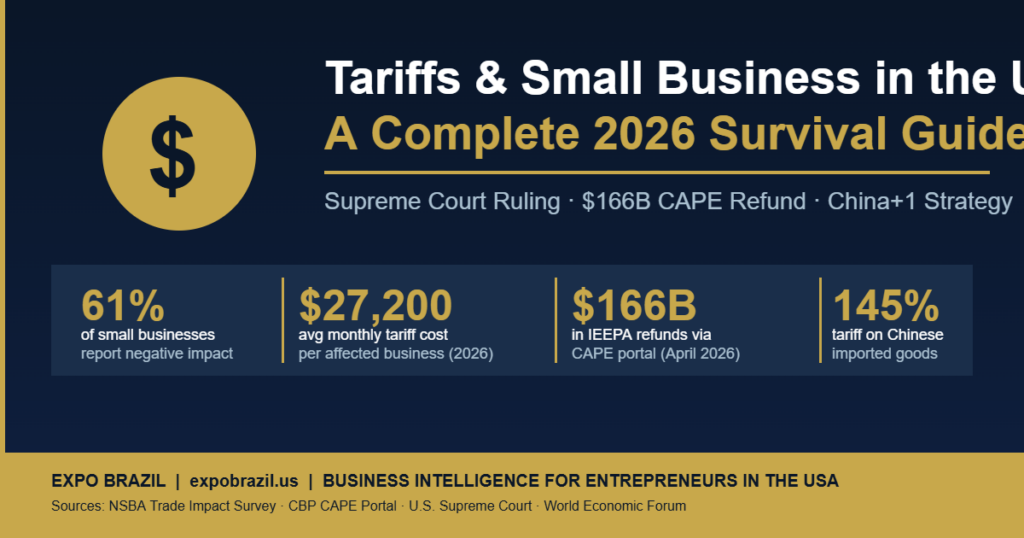
In 2026, U.S. tariffs on Chinese imports reached 145%, pushing average monthly customs payments for affected small businesses from $8,400 in January 2025 to $27,200 by January 2026 — a 224% increase in just 12 months, according to the National Small Business Association’s Trade Impact Survey. For the 61% of small business owners reporting negative operational impacts, this is not a theoretical trade policy debate: it is a direct cash flow crisis with immediate consequences for hiring, pricing, expansion, and survival.
This guide explains exactly where U.S. tariffs stand as of May 2026, what the Supreme Court’s February 2026 ruling means for your business, how to claim your share of the $166 billion CAPE refund fund, and which strategies U.S. entrepreneurs — including Brazilian business owners — are using to adapt, protect margins, and continue growing.
The 2026 Tariff Landscape: What U.S. Small Businesses Are Facing
By early 2026, the United States maintained some of the highest average import tariffs since the Smoot-Hawley era of the 1930s. Tariffs on goods from China stood at 145%, while the average tariff rate across all U.S. trading partners reached approximately 17%, according to the World Economic Forum’s January 2026 trade analysis.
The impact spread across virtually every sector: consumer goods, electronics, textiles, raw materials, food ingredients, packaging materials, and industrial machinery. Small businesses — which typically lack the trade compliance teams, hedge instruments, and negotiating leverage of large corporations — absorbed the highest proportional cost increases.
Key figures from the National Small Business Association’s 2026 Trade Impact Survey:
- 61% of small businesses report that 2026 tariffs negatively impacted their operations
- Average monthly tariff payments for affected businesses rose from $8,400 to $27,200 between January 2025 and January 2026
- 81.5% of affected owners raised or considered raising prices (Main Street Alliance)
- 41.7% delayed or considered delaying business expansion
- Nearly one-third anticipated potential layoffs
- Average total tariff payments per importing small business reached $306,000 in 2025 (Center for American Progress)
The Supreme Court’s February 2026 Ruling: A Turning Point for Entrepreneurs
On February 20, 2026, the U.S. Supreme Court issued a landmark ruling in Learning Resources Inc. v. Trump, holding that the International Emergency Economic Powers Act (IEEPA) does not authorize the president to impose sweeping, open-ended tariffs. The decision struck down the primary legal mechanism behind the most aggressive tariff regime in modern American trade history.
For small business entrepreneurs, the ruling created three major consequences:
- Refund eligibility: Tariffs collected under IEEPA authority became legally refundable, opening access to a $166 billion fund.
- Improved policy predictability: Future tariffs must be enacted through clearer statutory channels — meaning more legislative debate, more notice, and more time for businesses to adjust procurement strategies.
- Ongoing legal complexity: The administration has signaled it will contest certain refund claims, and documentation requirements remain extensive, particularly for businesses without dedicated trade compliance teams.
According to the Thomson Reuters Institute, entrepreneurs should not expect immediate or automatic relief — but those who act quickly and document carefully stand to recover significant funds.
The $166 Billion CAPE Refund Portal: How to Claim Your Money
In April 2026, U.S. Customs and Border Protection (CBP) launched the CAPE portal — Consolidated Administration and Processing of Entries — giving U.S. importers their first formal mechanism to apply for refunds on tariffs ruled unconstitutional by the Supreme Court.
Who Can Apply?
The importer of record — the business entity that paid the tariffs — or the licensed customs broker who filed entries on that business’s behalf.
How to File
File a CAPE Declaration through the ACE Secure Data Portal (ACE Portal) using a CSV file. Step-by-step instructions are available at cbp.gov under Trade Remedies / IEEPA Duty Refunds.
Eligibility and Timeline
- Phase 1 covers unliquidated entries and entries liquidated within the past 80 days
- Accepted refunds are typically issued within 60 to 90 days of CAPE Declaration acceptance
- For already-liquidated entries: the 80-day window from the liquidation date is strict — missing it forfeits eligibility on those specific entries permanently
Action required now: If your business has been importing goods subject to IEEPA tariffs and your entries have recently been liquidated, consult a licensed customs broker immediately. The 80-day window is running.
Frequently Asked: Can small businesses get a refund for IEEPA tariffs paid in 2025 and 2026?
Yes. Following the U.S. Supreme Court’s February 20, 2026 ruling in Learning Resources Inc. v. Trump, U.S. Customs and Border Protection launched the CAPE portal in April 2026. Eligible importers of record — including small businesses — can file CAPE Declarations through CBP’s ACE Secure Data Portal. Phase 1 covers unliquidated entries and entries liquidated within the past 80 days. Refunds are typically issued within 60 to 90 days of a successful CAPE Declaration acceptance.
5 Proven Strategies to Protect Your Business from Tariff Pressure in 2026
According to GGI (Gray Group International), nearly 60% of U.S. small and medium businesses now deploy two or more tariff mitigation strategies simultaneously. Here are the most effective approaches:
1. Diversify Your Supply Chain (China+1 Strategy)
The “China Plus One” approach means maintaining your existing Chinese supplier relationships while developing at least one alternative source in a lower-tariff country. Top alternatives in 2026 include Mexico (USMCA advantages, proximity), India (pharmaceuticals, chemicals, textiles), Indonesia (palm oil, rubber, basic manufacturing), Thailand (automotive parts, food processing), and Vietnam (textiles, footwear).
For Brazilian entrepreneurs in the United States, Mexico offers a particularly practical option given USMCA trade advantages and proximity. Many Brazilian-owned businesses in Florida and Texas have already shifted partial procurement to Mexican suppliers.
2. Renegotiate Supplier Contracts
Review all existing supplier agreements for tariff escalation clauses. Many suppliers — especially those in China — are willing to negotiate price adjustments to retain U.S. clients. Document all discussions in writing and ensure contracts specify which party bears the cost of future tariff changes.
3. Adjust Pricing Transparently
Price increases are often unavoidable, but how they are communicated matters enormously. Gradual, transparent adjustments tied to tangible value — improved packaging, extended warranties, loyalty incentives — preserve customer relationships better than sudden, unexplained increases.
4. Build a Tariff Reserve Fund
Treat potential tariff costs as a line item in your annual budget. Set aside a monthly reserve — at minimum 10% of your average tariff expense — in a dedicated business savings account. This buffer allows you to absorb sudden cost increases without disrupting payroll, inventory, or debt obligations.
5. Hire or Consult a Licensed Customs Broker
For any business importing more than $50,000 worth of goods annually, the cost of a licensed customs broker typically delivers 3–5x returns through tariff classification optimization, duty drawback programs, and refund claim management. The CAPE portal process in particular is complex — a broker can identify eligible entries and file declarations correctly within the 80-day window.
What This Means for Brazilian Entrepreneurs in the United States
Brazilian-owned businesses in the United States span a wide range of sectors — beauty, food and beverage, retail, construction, logistics, professional services, and manufacturing. While service-based businesses are largely insulated from direct tariff costs, those that import physical goods — ingredients, products, packaging, raw materials, or equipment — face direct exposure to the current tariff regime.
Brazilian entrepreneurs with established businesses in Florida, Texas, California, and New York should conduct an immediate tariff audit: identify every imported item, determine its country of origin, and check whether it falls under any IEEPA tariff category that may now be eligible for a CAPE refund.
The broader implication is strategic: the current tariff environment is also creating new market gaps and business opportunities. As Chinese-made products become more expensive for American consumers, businesses that can source equivalent products from lower-tariff countries — or manufacture domestically — are gaining competitive advantage. This is a moment of disruption that historically favors agile small business operators over large corporations.
The Expo Brazil, the largest Brazilian entrepreneur expo in the United States, takes place on April 10–11, 2027, at Osceola Heritage Park in Kissimmee, FL — and will feature exhibitors and sessions addressing exactly these supply chain, financing, and business adaptation challenges facing the community.
Frequently Asked Questions About Tariffs and Small Business in the USA
Conclusion: The Window to Act Is Open — But It Won’t Stay Open Forever
The tariff environment of 2026 is one of the most complex operational challenges U.S. small business owners have faced in decades. With 61% of businesses reporting negative impacts, average monthly tariff costs nearly tripling, and a Supreme Court ruling reshaping the legal landscape, the margin for inaction has effectively disappeared.
The good news: entrepreneurs who act decisively have meaningful options. The CAPE refund portal offers a real opportunity to recover significant sunk costs — but the 80-day window on liquidated entries means the clock is ticking. The China+1 supply chain strategy — particularly with Mexico as the primary alternative — is reducing tariff exposure for thousands of small businesses. And the Supreme Court’s February 2026 ruling has introduced more predictability into the trade policy environment going forward.
For Brazilian entrepreneurs in the United States, the path forward is the same as it has always been: gather accurate information, move faster than larger competitors, and build resilient, diversified businesses. This is exactly the knowledge-sharing environment that Expo Brazil was built to foster.
Expo Brazil is more than an event. It is a business platform created to connect entrepreneurs, brands and opportunities in the United States.
The next edition of Expo Brazil will take place on April 10 and 11, 2027, from 11:00 AM to 5:00 PM, at Osceola Heritage Park, 1901 Chief Osceola Trail, Kissimmee, FL.
Learn more at https://expobrazil.us/ and follow us on Instagram: https://www.instagram.com/expobrazil/
References
- National Small Business Association. 2026 Trade Impact Survey. nsba.biz
- U.S. Customs and Border Protection. IEEPA Duty Refunds / CAPE Portal. cbp.gov
- Fortune. $166 billion in tariff refunds just became available. fortune.com (April 20, 2026)
- NPR. Small business owners queue up for tariff refunds. npr.org (April 20, 2026)
- Thomson Reuters Institute. Supreme Court’s tariff decision: What’s next for businesses and how to plan. thomsonreuters.com
- World Economic Forum. Navigating trade in 2026: 5 strategic shifts in business decisions. weforum.org (January 2026)
- GGI (Gray Group International). How 2026 Tariffs Are Reshaping Small Business. graygroupintl.com
- Center for American Progress. Tariff costs for small businesses report. americanprogress.org
- Main Street Alliance. Tariff Impact Survey on Small Business Owners. mainstreetalliance.org
- U.S. Chamber of Commerce CO-. Tariff Update: What the Supreme Court Decision Means for Small Business. uschamber.com
- Tax Foundation. Tariff household cost estimates 2025–2026. taxfoundation.org
Disclaimer
The information published in this article is based on publicly available data from reliable sources, official publications, and research available at the time of writing. Business statistics, market data, regulatory requirements, tax rules, and all other details referenced in this article are subject to change without prior notice.
Expo Brazil makes no representations or warranties — express or implied — regarding the accuracy, completeness, or timeliness of any information contained herein. This article is intended for general informational purposes only and does not constitute legal, financial, tax, or business advice. Readers are strongly encouraged to verify all information directly through official government agencies, licensed professionals, and authoritative sources before making any business, financial, or investment decisions.
Last updated: May 23, 2026 · Expo Brazil Editorial Team · Contact Us