
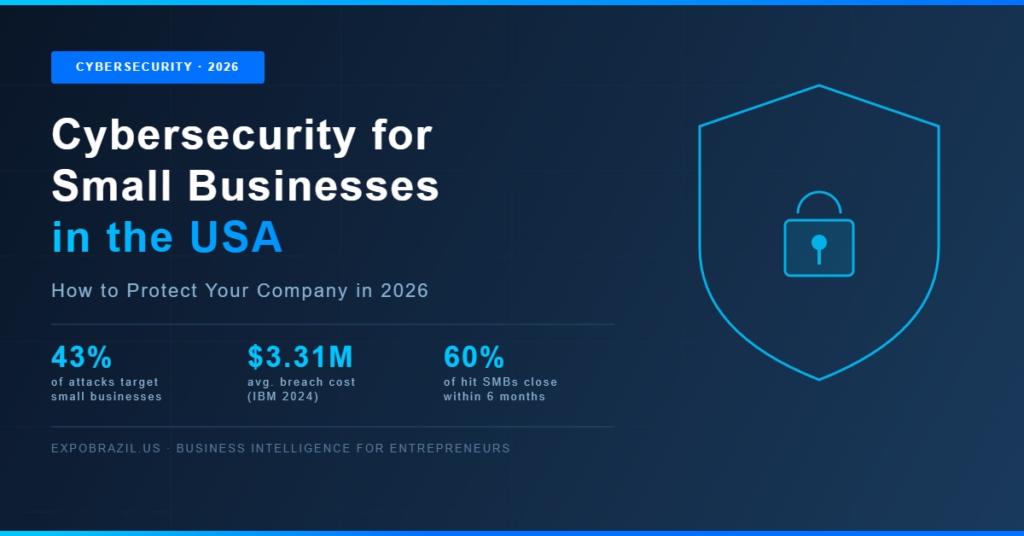
Small businesses in the United States face a cybersecurity crisis in 2026: 43% of all cyberattacks now target small and mid-sized businesses (SMBs), yet fewer than 14% of those businesses are prepared to defend themselves, according to the U.S. Cybersecurity and Infrastructure Security Agency (CISA). In 2025, losses to cybercrime reported to the FBI’s Internet Crime Complaint Center (IC3) exceeded $21 billion — a record high, up 26% from $16.6 billion in 2024.
For entrepreneurs — including the growing community of Brazilian business owners in the United States — understanding cyber threats is no longer optional. It is a survival skill.
Why Cybercriminals Target Small Businesses
Large corporations invest millions in cybersecurity infrastructure. Small businesses often cannot afford the same level of protection — and hackers know it. According to the 2025 Verizon Data Breach Investigations Report, 88% of SMB breaches involved ransomware, compared with 39% for large organizations.
The financial consequences are devastating. The IBM Cost of a Data Breach Report 2024 puts the average cost of a breach for organizations with fewer than 500 employees at $3.31 million. More critically, 60% of small businesses that suffer a cyberattack shut down within six months, according to the National Cybersecurity Alliance.
The Most Common Threats to Small Businesses in 2026
- Phishing attacks: Fraudulent emails that trick employees into revealing passwords or clicking malicious links. AI-generated phishing attacks have become 4.5 times more effective, making traditional training insufficient on its own.
- Ransomware: Malicious software that encrypts your business data and demands payment. Average ransom demands in 2025 reached $2 million, with recovery costs averaging $2.73 million.
- Business Email Compromise (BEC): Attackers impersonate executives or vendors to authorize fraudulent transfers. The FBI IC3 recorded more than $3 billion in BEC losses in 2025 alone.
- Data theft: Stealing customer data, financial records, or intellectual property — often to sell on the dark web or use for identity fraud.
Frequently Asked: How Much Does a Cyberattack Cost a Small Business?
The average cost of a cyberattack for a small business in the United States ranges from $120,000 to $1.24 million per incident, depending on the scale of the breach and the company’s security posture, according to IBM and the National Cybersecurity Alliance. For businesses with fewer than 500 employees, the IBM 2024 report found an average total breach cost of $3.31 million when factoring in downtime, legal fees, regulatory fines, and reputational damage. The financial impact is severe enough that 60% of attacked SMBs cease operations within six months.
Cybersecurity Statistics Every Entrepreneur Must Know in 2026
Here are the key data points from trusted American sources that define the current landscape:
- 80% of small businesses experienced at least one cyberattack in 2025 (National Cybersecurity Alliance)
- 43% of all cyberattacks worldwide target small businesses (CISA)
- 41% of SMB cyberattacks in 2025 were AI-driven (StationX Cybercrime Statistics)
- $21 billion in total cybercrime losses reported to FBI IC3 in 2025 — a new record
- 63% of small businesses saw their cyber insurance premiums increase by 200% or more in 2024 (Sagiss)
- 37% of SMBs that were attacked in 2025 lost more than $500,000 per incident
- Only 14% of small businesses rate their ability to defend against cyberattacks as highly effective (CISA)
How to Protect Your Small Business: A Practical 2026 Guide
The good news: many of the most effective cybersecurity measures are either free or low-cost. The U.S. Small Business Administration (SBA) and CISA both provide free resources, training, and vulnerability assessments for small businesses across the country.
1. Enable Multi-Factor Authentication (MFA) on All Accounts
MFA is the single most impactful security measure a small business can implement immediately and at zero cost. By requiring a second verification step — a text message code, an authenticator app, or a biometric scan — MFA blocks over 99.9% of automated credential attacks, according to Microsoft. Enable MFA on your email, banking, accounting software, social media, and any cloud storage platforms.
2. Train Your Team to Recognize Phishing
Human error is the leading cause of data breaches. CISA’s free Secure Your Business program offers training materials, simulated phishing exercises, and guidelines to build a security-aware culture in your organization. Run quarterly phishing simulation tests to keep staff alert.
3. Back Up Your Data — Offline and Offsite
Ransomware attacks become far less damaging when businesses maintain current, clean backups. Follow the 3-2-1 backup rule: keep 3 copies of your data, on 2 different storage types, with 1 copy stored offsite or in the cloud. Test your backups at least once per quarter. Disconnect backup drives from your network after each backup cycle.
4. Keep All Software and Systems Updated
Outdated software is the most exploited attack vector for SMBs. Enable automatic updates for your operating system, browsers, antivirus, plugins, and any business applications. The average time between a vulnerability being discovered and attackers exploiting it shrank to under 15 days in 2025, making timely patching critical.
5. Get a Free CISA Cybersecurity Assessment
CISA offers free Cybersecurity Performance Goal (CPG) assessments to businesses of any size. These assessments identify your most critical vulnerabilities and prioritize fixes by cost, impact, and complexity. Contact your local CISA cybersecurity advisor at cisa.gov/cyber-guidance-small-businesses to schedule a no-cost review.
6. Create a Cyber Incident Response Plan
Every business, regardless of size, should have a written plan for what to do if attacked. This includes: who to call, how to isolate affected systems, how to notify customers and regulators, and how to restore operations. The SBA provides a free Cybersecurity Action Plan template for small businesses.
Cybersecurity Challenges for Brazilian Entrepreneurs in the United States
Brazilian business owners operating in the United States face a unique set of cybersecurity challenges. Many businesses communicate across two languages and two countries, making phishing attempts harder to spot when they arrive in mixed-language or “urgent executive” formats. Cross-border payments and international banking transactions are also prime targets for Business Email Compromise scams.
Additionally, many immigrant entrepreneurs are in the growth phase — scaling teams, hiring first employees, adopting new software platforms — which creates new security gaps. Building a security culture from the start is far more effective than retrofitting security after a breach.
Events like Expo Brazil — the largest Brazilian entrepreneur expo in the United States — are increasingly incorporating business education sessions on topics like cybersecurity, digital compliance, and technology adoption. The Expo Brazil, scheduled for April 10–11, 2027, at Osceola Heritage Park in Kissimmee, FL, brings together hundreds of business owners, consultants, and service providers who can help entrepreneurs navigate these challenges.
Frequently Asked Questions About Cybersecurity for Small Businesses
Conclusion: Cybersecurity Is Not a Cost — It’s an Investment
In 2026, cybersecurity for small businesses in the USA is not a luxury reserved for large companies. With 43% of attacks targeting small businesses, $21 billion in annual cybercrime losses, and 60% of attacked businesses closing within six months, the risk is too significant to ignore. The encouraging reality is that CISA, the SBA, and dozens of technology partners offer free and low-cost tools that can dramatically reduce your risk exposure. Enabling MFA, training your team, backing up data, and creating a response plan costs very little — and could save everything.
For Brazilian entrepreneurs building businesses in the United States, protecting your digital infrastructure is as essential as your business license and your EIN. Build your defenses before you need them.
About Expo Brazil
Expo Brazil is more than an event. It is a business platform created to connect entrepreneurs, brands and opportunities in the United States.
The next edition of Expo Brazil will take place on April 10 and 11, 2027, from 11:00 AM to 5:00 PM, at Osceola Heritage Park, 1901 Chief Osceola Trail, Kissimmee, FL.
Learn more at https://expobrazil.us/ and follow us on Instagram: https://www.instagram.com/expobrazil/
References
- FBI Internet Crime Complaint Center (IC3) — ic3.gov — 2025 Internet Crime Report
- Cybersecurity and Infrastructure Security Agency (CISA) — Cyber Guidance for Small Businesses
- U.S. Small Business Administration (SBA) — Strengthen Your Cybersecurity
- IBM Cost of a Data Breach Report 2024 — ibm.com/security
- Verizon Data Breach Investigations Report 2025 — enterprise.verizon.com
- National Cybersecurity Alliance — staysafeonline.org
- Sagiss — Small Business Cybersecurity Statistics and Trends 2026 — sagiss.com
- StationX — Small Business Cybersecurity Statistics and Trends 2026 — app.stationx.net
- HIPAA Journal — 2025 Losses to Cybercrime Exceeded $20 Billion — hipaajournal.com
Disclaimer
The information published in this article is based on publicly available data from reliable sources, official publications, and research available at the time of writing. Business statistics, market data, regulatory requirements, tax rules, and all other details referenced in this article are subject to change without prior notice.
Expo Brazil makes no representations or warranties — express or implied — regarding the accuracy, completeness, or timeliness of any information contained herein. This article is intended for general informational purposes only and does not constitute legal, financial, tax, or business advice. Readers are strongly encouraged to verify all information directly through official government agencies, licensed professionals, and authoritative sources before making any business, financial, or investment decisions.
Last updated: May 24, 2026 · Expo Brazil Editorial Team · Contact Us