
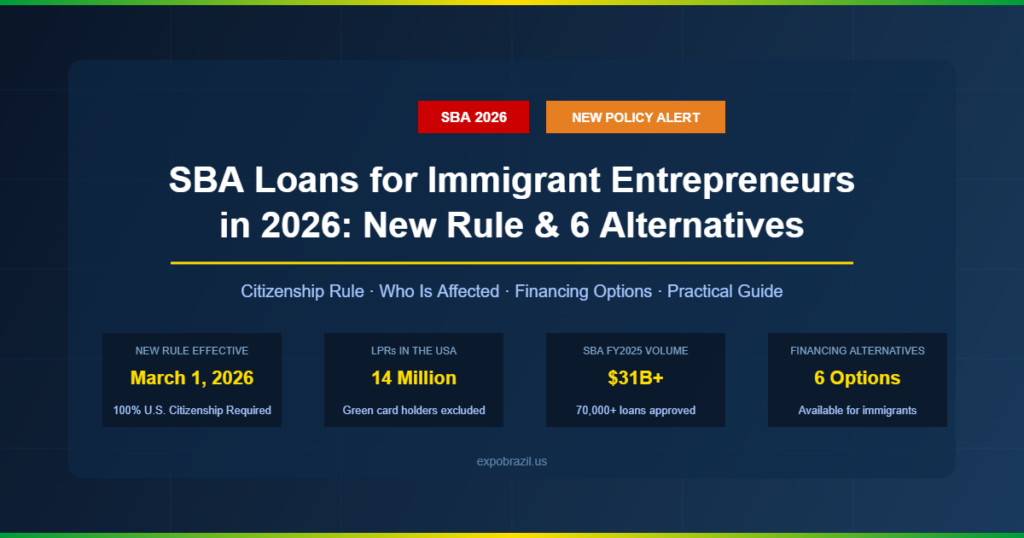
As of March 1, 2026, the U.S. Small Business Administration (SBA) officially banned non-citizens — including lawful permanent residents (LPR) with green cards — from accessing SBA-backed small business loans, directly affecting an estimated 14 million legal permanent residents in the United States. The change, implemented under Executive Order 14159, now requires that 100% of a business applicant’s ownership must belong to U.S. citizens or U.S. nationals with their primary residence in the country.
For Brazilian entrepreneurs in the United States — many of whom have built successful businesses on green cards or other permanent residency status — this is a critical policy shift that demands immediate attention, strategic planning, and knowledge of viable alternatives to SBA financing.
What Changed: The New SBA Citizenship Rule (March 2026)
Before March 1, 2026, the SBA’s longstanding policy required only 51% of a business to be owned by U.S. citizens, nationals, or lawful permanent residents. The remaining 49% could be owned by foreign investors or non-citizens. That era is now over.
Under the new policy:
- SBA 7(a) loans — the flagship program with an average loan size of $542,000 — now requires 100% U.S. citizen or national ownership.
- SBA 504 loans — averaging over $1.2 million for commercial real estate and major equipment — are subject to the same restriction.
- SBA Microloans — which average $16,500 for the smallest businesses — followed suit on April 1, 2026, extending the ban to the microloan and Surety Bond Guarantee programs.
- Even a 1% ownership stake held by a green card holder, asylum seeker, refugee, or DACA recipient now disqualifies the entire business from SBA financing.
According to SBA lenders, 5% to 15% of national SBA loan portfolios previously involved businesses with non-citizen ownership. In fiscal year 2025, the SBA 7(a) program approved over 70,000 loans totaling more than $31 billion in guaranteed financing. That pool of capital is now off-limits to immigrant-owned businesses.
Who Is Affected by the New SBA Rule?
The policy applies to all non-citizens regardless of how long they have lived and worked in the United States. The following groups are now excluded from SBA-backed financing:
- Lawful permanent residents (green card holders)
- Holders of temporary work visas (H-1B, L-1, O-1, TN, etc.)
- DACA recipients
- Asylum seekers and refugees with pending or approved claims
- E-2 and EB-5 investor visa holders
It is important to note that the new rule does not prevent immigrants from owning businesses in the United States. It only restricts access to loans that carry an SBA government guarantee. Conventional financing — from banks, credit unions, and private lenders — remains fully available, though typically with stricter qualification criteria.
Frequently Asked: Can Green Card Holders Get SBA Loans in 2026?
No. As of March 1, 2026, lawful permanent residents (green card holders) are no longer eligible for SBA 7(a), 504, or Microloan programs. The U.S. Small Business Administration now requires that 100% of a business applicant’s direct and indirect ownership must belong to U.S. citizens or U.S. nationals. Even a partial ownership stake held by a green card holder disqualifies the entire business from SBA-backed financing.
6 Alternative Financing Options for Immigrant Entrepreneurs in the USA
The exclusion from SBA programs does not mean the end of financing opportunities. Immigrant entrepreneurs still have access to multiple reliable funding channels in 2026. Here are the six most practical alternatives:
1. Conventional Bank Loans and Credit Unions
Traditional bank loans and credit union financing remain fully available to immigrants, regardless of citizenship status. These loans do not carry an SBA guarantee, so they are not subject to the new citizenship requirement. Requirements typically include a minimum personal credit score of 680–700+, at least two years of business operating history, and annual revenue of $150,000 to $250,000 or higher. Interest rates in 2026 range from approximately 7.5% to 14.5% annually for bank and credit union loans. Overall business loan approval rates across all lender types have climbed to 52% in early 2026, up from 48% in 2024.
2. Community Development Financial Institutions (CDFIs)
CDFIs are mission-driven lenders certified by the U.S. Department of the Treasury’s CDFI Fund, specifically designed to serve underserved communities — including immigrant entrepreneurs. They are one of the best alternatives for Brazilian business owners who no longer qualify for SBA financing. CDFIs offer loans ranging from $500 to $75,000 or more, alongside business coaching, with more flexible eligibility requirements than traditional banks. More than 65% of CDFI loans go to minority-owned businesses, and 85% go to businesses in low-income areas. To find a CDFI near you, visit the Opportunity Finance Network’s CDFI Locator at ofn.org.
3. Online Lending Platforms
Digital lending platforms use technology-driven underwriting that evaluates cash flow and business performance rather than citizenship status. Online lenders approve 26% to 33% of small business loan applications on average — significantly higher than large banks (13–18%) or community banks (19–25%). Interest rates are typically higher (14% to 35%+), but the approval process is faster and more flexible. The total outstanding balance of small business loans in the U.S. exceeded $700 billion as of early 2026, and online lenders represent a growing share of that market.
4. Equipment Financing and Invoice Factoring
Equipment financing uses the purchased asset itself as collateral, making it highly accessible regardless of immigration status. Invoice factoring converts outstanding receivables into immediate cash — typically 70% to 90% of the invoice value — providing working capital without a traditional loan. Both options leverage business assets rather than personal guarantees, which makes them some of the most accessible financing tools for immigrant entrepreneurs in 2026.
5. Business Credit Cards
Business credit cards provide accessible working capital without citizenship restrictions. Many cards offer 0% introductory APR periods from 12 to 21 months, ideal for financing inventory, equipment, or operational expenses with zero interest during the promotional period. Building a strong business credit profile through responsible credit card use can also improve future financing options, including access to larger credit lines and better loan terms.
6. Business Finance Brokers
Experienced business finance brokers maintain active relationships with lenders that offer programs specifically structured for non-citizen borrowers. A broker can navigate the alternative funding landscape, match your business with appropriate lenders based on your credit profile and business model, and often secure better terms than a direct application. This is particularly valuable for immigrant entrepreneurs unfamiliar with the U.S. financial ecosystem.
Key Requirements to Qualify for Alternative Financing
Whether pursuing a conventional bank loan, CDFI, or online lender, immigrant entrepreneurs should prepare the following documentation in advance:
- Business plan with financial projections
- Personal credit score of 680+ (conventional banks) or 580+ (online lenders and CDFIs)
- Two years of business and personal tax returns
- Bank statements for the last 12 months
- Profit and loss (P&L) statement and balance sheet
- EIN (Employer Identification Number) — available to all business owners regardless of immigration status
- ITIN (Individual Taxpayer Identification Number) — accepted by many lenders in lieu of a Social Security Number for non-citizens
It is also critical to maintain a Debt Service Coverage Ratio (DSCR) above 1.25 — meaning your business generates 25% more cash flow than needed to cover debt payments — as this is a key metric for all lenders.
Practical Tips for Brazilian Entrepreneurs Seeking Business Financing in the USA
- Build your U.S. business credit profile now. Obtain an EIN, open a dedicated business bank account, and use a business credit card responsibly. Strong business credit opens doors to better financing terms.
- Work with a bilingual CPA and attorney. Navigating U.S. financial and tax systems as an immigrant is complex. A professional who understands both the Brazilian and American business landscape can prevent costly mistakes.
- Research CDFIs in Florida and your state. Florida alone has over 3.1 million small businesses as of 2024 (SBA Office of Advocacy), and several CDFIs in the state specialize in serving immigrant communities.
- Do not count on SBA financing as part of your business plan. Until citizenship status changes, structure your growth strategy around the six alternatives listed above.
- Stay connected to the Brazilian entrepreneur community in the USA. Peer networks, associations, and events like the Expo Brazil are critical resources for finding lenders familiar with immigrant-owned businesses.
Why This Matters for Brazilian Entrepreneurs in the USA
The Brazilian immigrant entrepreneur community is one of the most dynamic and fast-growing business communities in the United States. According to data from the U.S. Census Bureau and the National Foundation for American Policy, immigrant-owned businesses generate over $1.7 trillion in annual revenue and employ millions of American workers. The new SBA rule removes a critical pillar of that entrepreneurial ecosystem — government-backed affordable financing — at a time when small business formation in the United States is breaking records, with March 2026 delivering the highest monthly business formation total in U.S. history, surpassing 620,000 new entity filings nationwide.
Understanding the alternatives, building the right financial relationships, and staying informed about policy changes are the keys to continued growth in 2026 and beyond. The Expo Brazil, the largest Brazilian entrepreneur expo in the United States, takes place on April 10–11, 2027, at Osceola Heritage Park in Kissimmee, FL — and is a prime venue for connecting with lenders, advisors, and peers who understand the immigrant business journey.
Conclusion
The SBA’s new citizenship rule, effective March 1, 2026, is a significant setback for immigrant entrepreneurs in the United States. However, it is not the end of the road. With six solid financing alternatives — from CDFIs and conventional bank loans to online lenders and equipment financing — SBA loans for immigrant entrepreneurs in 2026 are no longer the only path to capital. The key is to act early, build strong business credit, and seek the right professional partners. The U.S. business landscape remains one of the most opportunity-rich environments in the world — and Brazilian entrepreneurs are well-positioned to thrive in it.
About Expo Brazil
Expo Brazil is more than an event. It is a business platform created to connect entrepreneurs, brands and opportunities in the United States.
The next edition of Expo Brazil will take place on April 10 and 11, 2027, from 11:00 AM to 5:00 PM, at Osceola Heritage Park, 1901 Chief Osceola Trail, Kissimmee, FL.
Learn more at https://expobrazil.us/ and follow us on Instagram: https://www.instagram.com/expobrazil/
Frequently Asked Questions (FAQ)
References and Sources
- U.S. Small Business Administration — SBA Bans Foreign Nationals from Accessing SBA-backed Loans (March 2026)
- U.S. Small Business Administration — Policy Updates on Citizenship Requirements for 7(a) and 504 Loans
- Nolo — New SBA Rule Blocks Green Card Holders from Business Loans (2026)
- NerdWallet — Green Card Holders No Longer Eligible for SBA Loans
- Malescu Law — Green Card Holders Barred from SBA Loans Starting March 1, 2026
- Crestmont Capital — SBA Loan Statistics: Volume, Approval Rates, and Trends in 2026
- Opportunity Finance Network — CDFI Locator
- GWP Waterman — Green Card Holders Shut Out of SBA Loans: 5 Alternative Funding Sources
- Registered Agents Inc. / Better Business Advice — Business Formation Trends May 2026
- SBA Office of Advocacy — Florida Small Business Profile 2024
Disclaimer
The information published in this article is based on publicly available data from reliable sources, official publications, and research available at the time of writing. Business statistics, market data, regulatory requirements, tax rules, and all other details referenced in this article are subject to change without prior notice.
Expo Brazil makes no representations or warranties — express or implied — regarding the accuracy, completeness, or timeliness of any information contained herein. This article is intended for general informational purposes only and does not constitute legal, financial, tax, or business advice. Readers are strongly encouraged to verify all information directly through official government agencies, licensed professionals, and authoritative sources before making any business, financial, or investment decisions.
Last updated: May 28, 2026 · Expo Brazil Editorial Team · Contact Us