
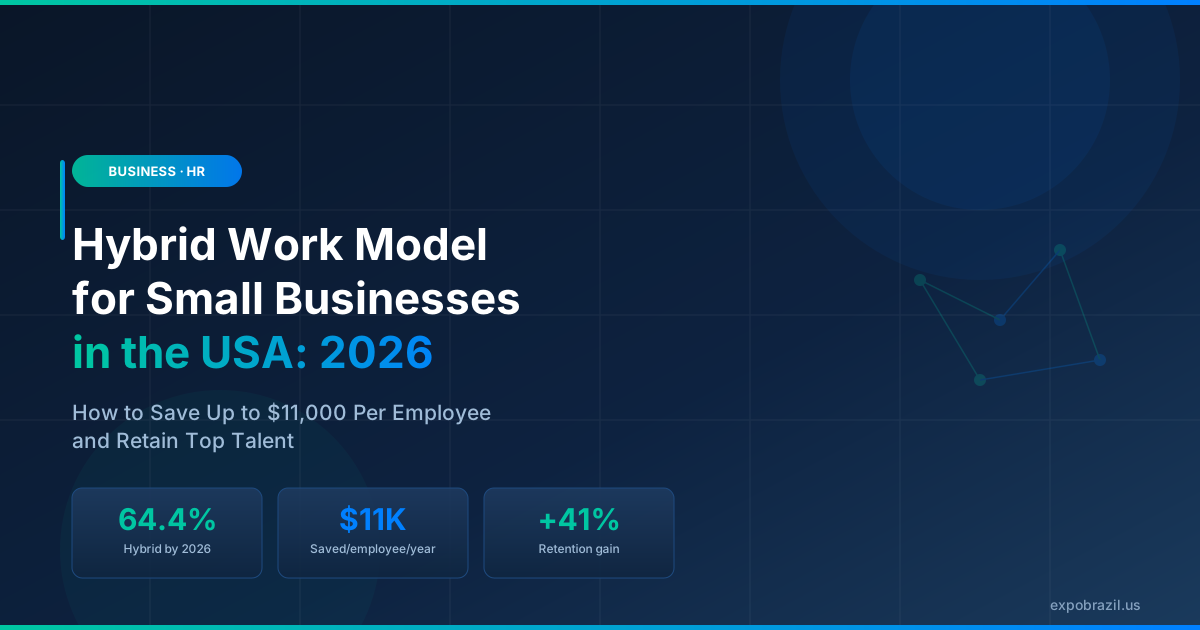
As of 2026, 64.4% of U.S. companies have adopted hybrid work schedules — making the hybrid model the dominant structure for knowledge-based roles in the American economy, according to data compiled by WorkTime and Vena Solutions. For small business owners, this shift represents one of the most powerful levers available to reduce operating costs, attract skilled workers, and retain employees in a competitive labor market.
Employers who implement well-structured hybrid arrangements save an average of $11,000 per employee per year through reduced office space, lower utilities, and fewer supply costs, according to Robert Half’s 2026 Remote Work Statistics report. For a small business with 10 employees, that translates to potential savings of $110,000 annually.
Why Hybrid Work Is Now a Business Imperative, Not a Perk
The data from 2026 is unambiguous: flexible work is no longer a recruitment benefit — it is a baseline expectation. According to SurveyMonkey’s Workplace Trends report, 76% of remote-capable workers say they would quit their job if required to return to the office full-time. Among workers in hybrid-capable roles, 83% actively prefer hybrid arrangements over fully in-person or fully remote setups.
For small business owners competing with large corporations for talent, this creates both a challenge and a strategic opportunity. Companies that formalize a hybrid work policy gain a measurable competitive edge in hiring and retention — without necessarily increasing payroll.
The Financial Case for Hybrid Work in Small Businesses
Beyond talent attraction, the cost savings are compelling. According to HRO Today and Gray Group International’s 2026 analysis:
- 79% of companies with a hybrid policy report cost savings in operational expenses.
- Companies transitioning to hybrid models reduce office space costs by 10% to 50%, depending on footprint and utilization strategy.
- Employers save an average of $11,000 per employee per year for each worker operating remotely 2–3 days per week.
- Companies requiring only one on-site day per week see employee retention improve by 41% on average.
- Stanford research tracking 1,600+ workers through 2025 found structured hybrid employees produced 4–8% more output than their fully in-office counterparts.
For a small business owner in Florida or another high-cost U.S. state, reducing real estate commitments — even partially — can significantly improve margins without cutting headcount or benefits.
How to Implement a Hybrid Work Policy: A Step-by-Step Guide for Small Businesses
Step 1 — Define Which Roles Are Hybrid-Eligible
Not every position can be performed remotely. Start by categorizing your roles: customer-facing positions (retail, restaurant, healthcare) typically require in-person presence, while administrative, marketing, sales, and design roles can often operate under a hybrid arrangement. Document the criteria clearly to avoid legal inconsistencies.
Step 2 — Set Clear In-Office Expectations
Structure drives performance. Stanford’s research confirms that structured hybrid — defined on-site days with clear rationale — outperforms both unstructured remote work and mandatory full-time office attendance. Most small businesses find that requiring 2–3 designated on-site days per week balances collaboration needs with the flexibility employees demand. According to Select Software Reviews, 55% of job seekers rank a hybrid schedule as their top preference, with most preferring 1–4 on-site days.
Step 3 — Invest in the Right Tools
A hybrid team needs reliable digital infrastructure. At minimum, small businesses should establish: a cloud-based project management platform (Asana, Monday.com, or Trello), a video communication system (Zoom or Google Meet), a shared document workspace (Google Workspace or Microsoft 365), and a secure VPN or cloud storage for sensitive files. These tools typically cost between $30 and $100 per employee per month — a fraction of the savings generated by reducing office space.
Step 4 — Create a Written Hybrid Work Policy
A formal written policy protects both the employer and the employee. It should cover: eligible roles, required on-site days and hours, communication standards and response time expectations, equipment provisions, performance evaluation criteria, and conditions under which the hybrid arrangement may be modified or revoked. Consult an employment attorney licensed in your state before finalizing any policy document.
Step 5 — Establish Performance Metrics
Hybrid work shifts management from presence-based to output-based. Define what success looks like for each role — weekly deliverables, project milestones, client satisfaction scores, or sales targets. Regular 1:1 check-ins (weekly or bi-weekly) help maintain alignment and prevent remote employees from feeling disconnected from company goals.
Frequently Asked: How Do I Implement Hybrid Work in a Small Business in the USA?
To implement a hybrid work model in a U.S. small business, start by identifying which roles can be performed remotely, then create a formal written policy specifying required on-site days, communication standards, and performance metrics. Equip your team with cloud-based tools such as Google Workspace, Zoom, and a project management platform. Employers who implement structured hybrid schedules save an average of $11,000 per employee per year and see retention improve by up to 41%, according to 2026 industry research.
Hybrid Work and the Brazilian Entrepreneur in the United States
For Brazilian entrepreneurs operating businesses in the U.S., the hybrid model offers a particularly strategic advantage. Many Brazilian-owned small businesses in states like Florida, Texas, and New York operate in sectors where hybrid arrangements are entirely viable — including real estate, marketing, consulting, technology, and professional services.
The United States is home to 18.1 million digital nomads as of 2026, a 147% increase since 2019, according to MBO Partners. Brazilian professionals with work authorization are increasingly joining this workforce, creating talent pools that Brazilian-owned businesses in the U.S. are uniquely positioned to recruit from.
Additionally, hybrid flexibility allows Brazilian entrepreneurs to manage teams that may include workers across different time zones — including contractors in Brazil — while maintaining a U.S.-registered business presence and meeting local labor requirements for employees based in the United States.
Common Mistakes to Avoid When Implementing Hybrid Work
- No written policy: Verbal agreements are unenforceable and create legal risk.
- Inequitable application: Applying hybrid eligibility differently across similar roles exposes employers to discrimination claims.
- Ignoring state-specific labor laws: Some U.S. states (notably California and New York) have specific regulations around remote work expenses, reimbursements, and tax nexus.
- Underinvesting in tools: Expecting a remote or hybrid team to function without proper communication infrastructure leads to productivity loss.
- No policy review cycle: Business needs evolve. Build a 6-month policy review into your written agreement.
Hybrid Work by the Numbers: Key 2026 Statistics
- 64.4% of U.S. companies rely on hybrid schedules in 2026 (WorkTime)
- $11,000 average annual savings per remote employee (Robert Half)
- 79% of companies with hybrid policies report cost savings (HRO Today)
- 76% of remote-capable workers would quit without flexibility (SurveyMonkey)
- 41% retention improvement with one on-site day per week (Gray Group International)
- 83% of workers prefer hybrid arrangements (Robert Half)
- 4–8% productivity gain for structured hybrid teams (Stanford University)
- 18.1 million digital nomads in the U.S. in 2026 (MBO Partners)
Frequently Asked Questions
Conclusion
The hybrid work model is no longer experimental — it is the operational standard for competitive small businesses in the United States in 2026. With 64.4% of companies already on hybrid schedules, average savings of $11,000 per employee per year, and retention improvements up to 41%, the case for hybrid work has never been stronger.
For Brazilian entrepreneurs building or growing businesses in the U.S., adopting a formal hybrid work policy is one of the highest-leverage decisions in 2026 — reducing overhead, strengthening hiring, and positioning your company for sustainable growth in the American market.
Connect with the Brazilian Business Community in the USA
Expo Brazil is more than an event. It is a business platform created to connect entrepreneurs, brands and opportunities in the United States.
The next edition of Expo Brazil will take place on April 10 and 11, 2027, from 11:00 AM to 5:00 PM, at Osceola Heritage Park, 1901 Chief Osceola Trail, Kissimmee, FL.
Learn more at https://expobrazil.us/ and follow us on Instagram: https://www.instagram.com/expobrazil/
References
- Robert Half — Remote Work Statistics and Trends 2026
- WorkTime — Remote Work in 2026: 50+ Key Statistics
- Vena Solutions — Remote Work Statistics for 2026
- SurveyMonkey — The Workplace Today: 2026 Remote and Hybrid Work Trends
- Gray Group International — The Complete Guide to Hybrid Work Policies in 2026
- HRO Today — Hybrid Work Results in Cost Savings and Increased Employee Happiness
- Select Software Reviews — How to Implement a Hybrid Work Policy for 2026
- Founder Reports — Essential Return-to-Office Statistics and Trends 2026
Disclaimer
The information published in this article is based on publicly available data from reliable sources, official publications, and research available at the time of writing. Business statistics, market data, regulatory requirements, tax rules, and all other details referenced in this article are subject to change without prior notice.
Expo Brazil makes no representations or warranties — express or implied — regarding the accuracy, completeness, or timeliness of any information contained herein. This article is intended for general informational purposes only and does not constitute legal, financial, tax, or business advice. Readers are strongly encouraged to verify all information directly through official government agencies, licensed professionals, and authoritative sources before making any business, financial, or investment decisions.
Last updated: May 27, 2026 · Expo Brazil Editorial Team · Contact Us