
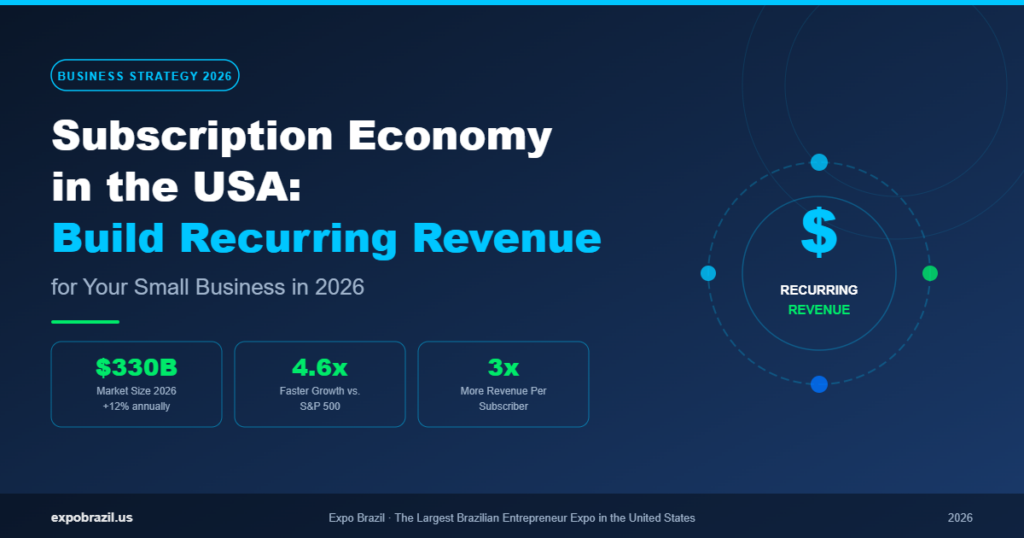
The subscription economy in the United States exceeded $330 billion in 2026 — growing at 12% annually — and subscription-based companies have grown 4.6 times faster than the S&P 500 over the past decade, according to data compiled by Zuora’s Subscription Economy Index and confirmed by industry research from Swell and Digital Applied. For small business owners in the USA, this shift represents one of the most powerful structural opportunities of the decade: the ability to replace unpredictable one-time sales with stable, compounding monthly recurring revenue (MRR).
What Is the Subscription Economy and Why It Matters for Small Businesses
The subscription economy refers to the business model in which customers pay a recurring fee — weekly, monthly, or annually — to access a product or service continuously. Unlike traditional transactional commerce, subscription businesses generate predictable, compounding revenue that makes financial planning, hiring, and investment significantly easier.
The global subscription e-commerce market is projected to exceed $859 billion by 2026 (Digital Applied, 2026). In the United States alone, the average consumer holds 5.6 active subscriptions across categories including media, software, wellness, and lifestyle services. This behavior normalizes recurring payments and makes it easier than ever for small business owners to introduce subscription tiers to their own customers.
The financial argument is compelling: subscribers generate 3x more revenue per customer than non-subscribers over their lifetime (Swell, 2026). And a business with even a modest base of 500 subscribers paying $49/month generates $24,500 in predictable MRR — a foundation that de-risks growth and unlocks financing options traditional project-based businesses cannot access.
Subscription Models That Work for Small Businesses in the USA
Not all subscription businesses are SaaS companies. The model has expanded into virtually every sector of the economy. Here are the most accessible subscription formats for small business owners in the United States:
1. Product-of-the-Month / Subscription Boxes
Curated product boxes — beauty, food, pet care, books, coffee — represent one of the most scalable formats for product-based businesses. The U.S. subscription box industry is projected to exceed $32 billion by 2026 (Swell, 2026). Platforms like Cratejoy and Subbly make it possible to launch a box business with minimal upfront technology investment. Margins are often 40–60% when sourcing is optimized.
2. Service Retainers
Agencies, consultants, accountants, lawyers, and marketing professionals are increasingly packaging their services into monthly retainers instead of hourly billing. A consulting retainer of $2,500/month with just 20 clients generates $50,000 in predictable monthly revenue — without acquiring a single new client in that billing cycle.
3. Digital Content and Online Communities
Platforms like Substack, Beehiiv, and Patreon have enabled individual creators and entrepreneurs to build paid newsletters and online communities. Top-performing newsletter operators on Substack earn between $5,000 and $50,000 per month, with near-zero cost of goods sold. For entrepreneurs with subject-matter expertise, this model offers exceptional margins and global reach.
4. Software-as-a-Service (SaaS)
No-code and low-code platforms have dramatically lowered the barrier to launching SaaS tools. Entrepreneurs can now build and monetize software without a technical co-founder. The SaaS market in the United States exceeds $300 billion and continues to grow at double-digit rates as businesses of all sizes adopt specialized tools for workflow automation, communication, and analytics.
5. Meal Kits and Food Subscriptions
The U.S. meal-kit and prepared-meal subscription sector is projected to surpass $14 billion by 2026, driven by demand for healthy, convenient food options. Immigrant entrepreneurs — particularly those from countries with distinctive and beloved food cultures — are well positioned to offer premium ethnic cuisine subscriptions with authentic ingredients and recipes.
Frequently Asked: How Do I Start a Subscription Business in the United States?
To start a subscription business in the USA, you need to: (1) identify a recurring problem or desire your target customer experiences monthly; (2) design a compelling offer — product, service, or content — that resolves it continuously; (3) choose a subscription platform such as Shopify (for product subscriptions), Stripe Billing (for service retainers), or Substack (for newsletters); (4) register your business as an LLC or Corporation; and (5) set pricing tiers. The cost to register an LLC in Florida is $125, and most subscription platforms charge 1–3% of transaction volume. You can legally launch a U.S. subscription business in under 30 days.
How to Price Your Subscription: The Three-Tier Strategy
Pricing is the single most important lever in subscription economics. Research consistently shows that three-tier pricing captures 60% more revenue than single-tier offers (Ordway Labs, 2026). The standard framework is:
- Starter Tier — Low price, limited features. Goal: reduce the barrier to entry and build the subscriber base.
- Core Tier — The primary offer, priced to be the “obvious choice.” Most subscribers should land here.
- Premium/VIP Tier — High-touch, high-value. Goal: capture heavy users and boost average revenue per user (ARPU).
Annual plans are a critical upsell: annual subscribers are 40% less likely to cancel than monthly subscribers and generate significantly higher customer lifetime value (CLV). Offering a 15–20% discount for annual commitment is a proven strategy to reduce churn and improve cash flow for planning purposes.
The Metric That Determines Your Subscription Business Health: Churn Rate
Churn rate — the percentage of subscribers who cancel each billing cycle — is the most critical metric in subscription businesses. A business with a 10% monthly churn rate loses 72% of its subscriber base in 12 months, even if it continuously acquires new customers. Sustainable subscription businesses target a monthly churn rate below 5% and an annual churn rate below 20%.
Research from Bain & Company shows that a 5% improvement in customer retention rates leads to a 25–95% increase in profits, depending on the industry. This means that small improvements in churn — through better onboarding, proactive customer success, and regular value delivery — can dramatically compound earnings over time.
Subscription Business Opportunities for Brazilian Entrepreneurs in the USA
Brazilian entrepreneurs in the United States occupy a unique strategic position. With an estimated 1.8 million Brazilians living in the U.S. — concentrated in Florida, Massachusetts, New York, and Texas — there is a large, underserved audience with distinct cultural preferences, language needs, and community ties. Several subscription models are particularly well-suited to this community:
- Brazilian food and ingredient subscription boxes — delivering authentic Brazilian pantry staples, snacks, or meal kits to the diaspora across the country
- Portuguese-language business education newsletters or communities — serving Brazilian entrepreneurs who prefer to consume content in their native language
- Legal and accounting retainer services for immigrants — particularly for tax planning, visa compliance, and business registration needs specific to the Brazilian immigrant experience
- Beauty and wellness subscription boxes — curated with Brazilian brands and culturally relevant products, including hair care, skincare, and natural ingredients
The advantage is clear: a Brazilian entrepreneur serving Brazilian subscribers in the United States starts with built-in cultural authority and brand trust — a competitive moat that generic American competitors cannot easily replicate.
Tools and Platforms to Launch Your Subscription Business in the USA
The technology infrastructure for launching subscription businesses in 2026 is accessible, affordable, and largely no-code. Here are the most widely used platforms by U.S. small business owners:
- Shopify + Recharge or Bold Subscriptions — for physical product subscriptions and e-commerce. Shopify hosts over 2.67 million active stores in the U.S. alone (Chargeflow, 2026).
- Stripe Billing — for service-based subscription billing, retainers, and SaaS. Handles automatic renewals, failed payment recovery, and tax compliance in all 50 states.
- Substack / Beehiiv — for paid newsletter subscriptions and digital content communities. Substack alone has over 35 million active paid subscribers globally.
- Memberful / Circle — for online community memberships, exclusive content, and coaching programs.
- Cratejoy — a dedicated subscription box marketplace that allows new box businesses to find their first subscribers through an existing audience of millions of box shoppers.
Frequently Asked: What Credit Score Do I Need to Start a Subscription Business in the USA?
Launching a subscription business in the United States typically requires no minimum credit score for the business model itself — subscriptions are funded directly by recurring customer payments. However, if you plan to use business credit cards, apply for SBA loans, or open a business line of credit to fund growth, lenders typically require a minimum personal FICO score of 620–680 for traditional bank products, or 550+ for alternative lenders. Building a business entity (LLC or Corporation) and opening a dedicated business bank account from day one accelerates business credit-building independently of personal credit.
The Expo Brazil Connection: Subscriptions as a Growth Engine for Your Business
The Expo Brazil, the largest Brazilian entrepreneur expo in the United States, takes place on April 10–11, 2027, at Osceola Heritage Park in Kissimmee, FL. For subscription business owners, trade events like Expo Brazil are critical growth engines: they offer direct access to a concentrated pool of potential B2B subscribers, strategic partners, and brand collaborators — all in a single venue and a single day.
Whether you are launching a service retainer subscription for business clients, a B2B newsletter for the Brazilian entrepreneur community, or a product box for the diaspora, being present at Expo Brazil positions your brand in front of over 4,000 decision-makers who are actively investing in their businesses. The 2026 edition hosted more than 140 exhibitors and reached over 500,000 people through social media — a scale that few independent marketing campaigns can match.
Conclusion
The subscription economy in the USA is not a trend reserved for Silicon Valley startups. It is a proven business model — growing at 12% annually and generating billions in annual recurring revenue across every industry sector — that is fully accessible to small business owners, service providers, and immigrant entrepreneurs today. The subscription economy exceeded $330 billion in the United States in 2026 and is projected to continue its expansion. Small businesses that build a recurring revenue layer into their operations today will create a compounding financial advantage that outperforms traditional transactional models over the next decade. The tools exist, the platforms are affordable, and the demand is documented. The opportunity is in the execution.
FAQ: Subscription Economy for Small Business Owners in the USA
References
- SBA Office of Advocacy – Frequently Asked Questions About Small Business 2026. advocacy.sba.gov
- Digital Applied – Subscription Commerce 2026: Recurring Revenue Guide. digitalapplied.com
- Swell – 35 Recurring Revenue Model Statistics. swell.is
- SQ Magazine – Subscription Economy Statistics 2026. sqmagazine.co.uk
- Ordway Labs – Subscription Business Model Guide 2026. ordwaylabs.com
- Shopify – How to Start a Subscription Business. shopify.com
- Chargeflow – Shopify Statistics 2026. chargeflow.io
- Baytech Consulting – Unlocking Recurring Revenue: The Subscription Economy in 2026. baytechconsulting.com
Expo Brazil 2027
Expo Brazil is more than an event. It is a business platform created to connect entrepreneurs, brands and opportunities in the United States.
The next edition of Expo Brazil will take place on April 10 and 11, 2027, from 11:00 AM to 5:00 PM, at Osceola Heritage Park, 1901 Chief Osceola Trail, Kissimmee, FL.
Learn more at https://expobrazil.us/ and follow us on Instagram: https://www.instagram.com/expobrazil/
Disclaimer
The information published in this article is based on publicly available data from reliable sources, official publications, and research available at the time of writing. Business statistics, market data, regulatory requirements, tax rules, and all other details referenced in this article are subject to change without prior notice.
Expo Brazil makes no representations or warranties — express or implied — regarding the accuracy, completeness, or timeliness of any information contained herein. This article is intended for general informational purposes only and does not constitute legal, financial, tax, or business advice. Readers are strongly encouraged to verify all information directly through official government agencies, licensed professionals, and authoritative sources before making any business, financial, or investment decisions.
Last updated: May 26, 2026 · Expo Brazil Editorial Team · Contact Us